How to Start a Travel Baseball Team: A Step-by-Step Guide

Sierra Swigert Last updated: February 25, 2026

Table of Contents
For aspiring young baseball players, joining a travel team is a great way to gain experience, hone their skills, and develop strong team bonds. If your area doesn’t have a travel baseball team, you can start your own for young athletes in your community.
Launching a brand-new team may seem daunting, but you can make it happen with a strong game plan and dedicated coaches, parents, and volunteers. Finding players is just the first step: you’ll also need to organize tryouts and practices, create a budget, and manage team communications.
Planning ahead makes these administrative tasks manageable so your season runs smoothly. Let’s break down how to start and manage a travel baseball team, step by step.

Finding coaches and volunteers
Coaches and volunteers are the heart of any baseball team so your first priority should be finding reliable, trustworthy adults to manage your team.
First, you’ll need to find your coaching staff — usually a head coach and an assistant coach. While some travel ball coaches expect a salary, you may want to focus on those willing to volunteer (unless you’ve created a budget for coach salaries). Talk with coaches in your area to set realistic expectations.
You’ll also need volunteers to help with administrative tasks and travel coordination. The bonus here is that many parents want to be involved with their child’s baseball team, so get in touch with them first.
You can also reach out to your local athletic community to find volunteers. For example, many retired baseball coaches like to stay involved by volunteering. If your travel ball team is for younger players, high school or college athletes can be great volunteers; they can build leadership skills and are already familiar with the game.
Transparency is key here: volunteering for a travel baseball team is a significant time commitment. Volunteers will need to help out at practices and tournaments every week during the season. Make sure they understand what they’re signing up for and have time in their schedule. To help, you can set expectations during a group planning session by discussing volunteer responsibilities, team culture, safety, and your code of conduct.
🧠 Learn: How to Recruit and Keep Volunteers
Defining roles for a smooth season
Establishing roles for each team member creates clarity about who’s responsible for what, so you can work together efficiently.
Here are some of the most common roles for travel baseball organizations, plus their primary responsibilities:
- Head coach: The head coach oversees the team’s on-field strategy. They create rosters, develop training tactics, keep players motivated, and make game-time decisions.
- Assistant coach: The assistant coach supports the head coach and helps players with skill development. Some travel teams will have several assistant coaches, each focused on a different position.
- Team administrator: The administrator handles a variety of tasks, including booking practice facilities, managing equipment and uniforms, promoting the team, and delegating work. Administrators keep things running smoothly off the field, so coaches and athletes can focus on the game.
- Treasurer: The treasurer is responsible for the team’s budget and funding. They handle player fees, travel expenses, equipment costs, and other key transactions. They also maintain the team’s financial records and handle tax payments as needed.
- Travel coordinator: The travel coordinator handles transportation, lodging, meals, and other logistics for out-of-town tournaments and games.
- Communications lead: The communications lead is responsible for clear communication with players, parents, and volunteers. They send out team schedules, post updates online, and serve as the primary point of contact for parents with questions.
Budgeting and fundraising for your season
Budgeting can be one of the most challenging parts of building a travel baseball team. To minimize stress for everyone, create a detailed budget before the season starts, so you don’t have to worry about running out of money.
Here are some of the most common costs for travel baseball teams:
- Uniforms: Every athlete needs a team uniform that fits comfortably.
- Equipment: Travel baseball teams need items like balls, mitts, helmets, and bats.
- Practice facility rentals: Travel teams usually aren’t affiliated with a school or rec center, which means you’ll need to find practice facilities. Ongoing rental costs should be part of your budget.
- League registration: To play travel baseball games, you’ll need to join a league, and both your team and your players will need to pay a registration fee. Many leagues also require teams to pay for their own insurance.
- Tournament fees: Each travel baseball tournament has entry fees for players and teams, which should be part of your budget.
- Travel costs: Some travel teams provide buses and meals and even arrange hotel blocks for players. When creating your budget, differentiate between shared team costs (covered by your organization) and individual player costs (covered by players and their families).
For example, facility rentals and equipment are team costs, while uniforms and individual tournament fees are player costs. Create (and distribute!) a document that outlines your budget and who's covering what.
⬇️ Download: Travel Baseball Team Budget Spreadsheet Template
Fundraising and sponsorship ideas
Individual player fees aren’t the only way to cover costs for a youth travel baseball team. Fundraising provides additional financial support, and you can use it to build scholarship funds and make baseball more accessible to talented players, regardless of their financial situation.
Here are some simple, effective ways to fundraise for your travel baseball team:
- Host community events: Fun activities like bake sales, trivia nights, concerts, or car washes get the entire community involved.
- Create online fundraisers: With online fundraisers, friends and family can donate regardless of where they live. Share your fundraisers on social media.
- Partner with local businesses: Many small businesses are happy to sponsor local teams in exchange for a uniform logo or advertising at home games.
- Run youth sports clinics: These events are a great way to raise money and recruit new players.
📚 Read: Easy Baseball Fundraising Ideas
Building your team’s brand and visibility
A strong brand identity can make your team look professional and help you recruit players. Good branding also helps you build a local fan base among family and friends.
Branding starts by creating a logo to use on your website, social media, and uniforms. The logo doesn’t have to be complicated — oftentimes, simple, clean images look the most sophisticated. Also, create both a color and a black-and-white version for different contexts.
Creating a website for your team
Next, create a website to serve as your team’s online hub. Websites make it easy for players and their families to find the information they need about schedules, forms, payments, and other communications. With this information available directly on your website, you’ll spend less time answering questions from players and parents.
Having a website also lends credibility to your team. You don’t need any tech experience to build a great website. Instead, use a sports-focused website builder like Jersey Watch to guide you through the process.
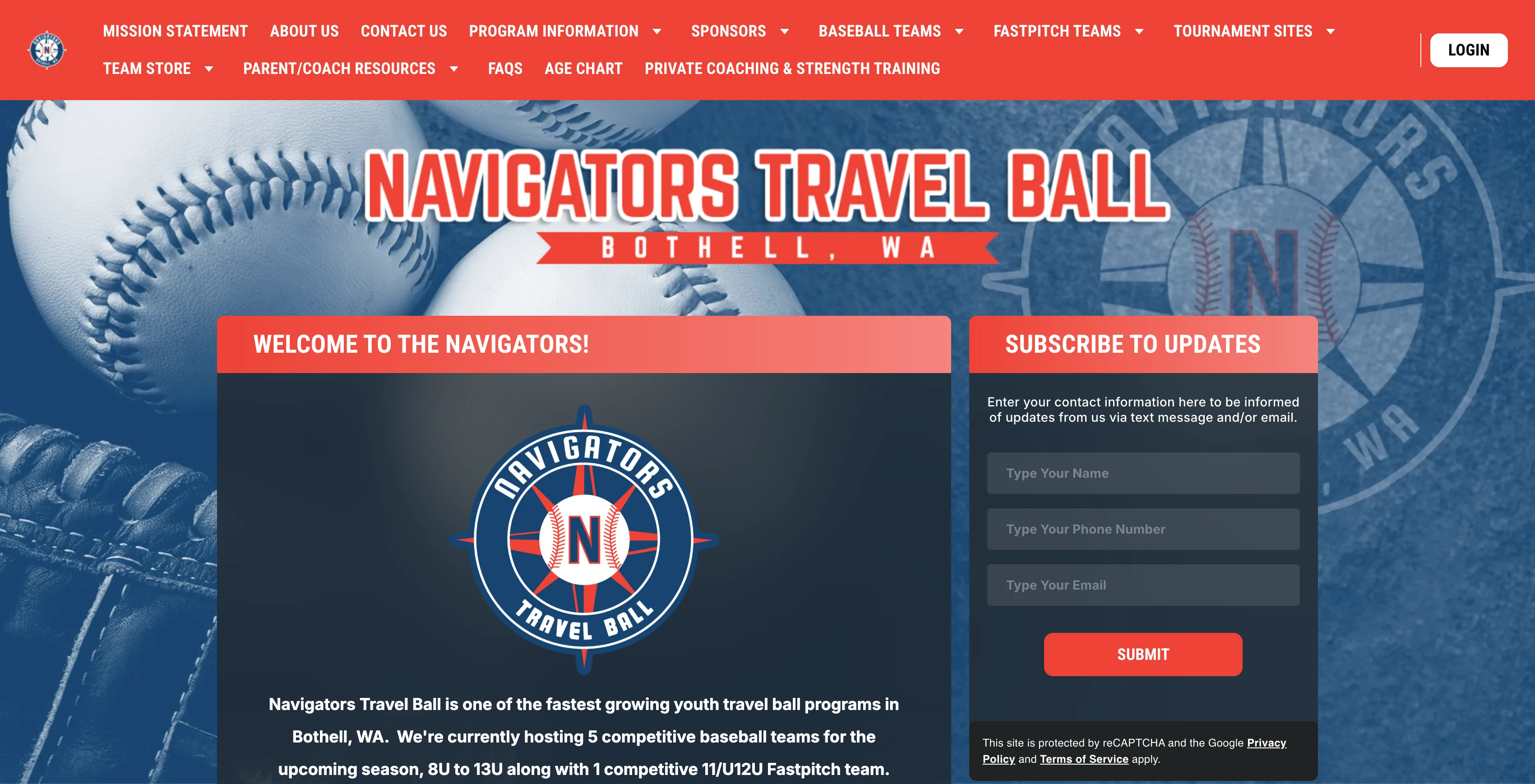
A travel baseball website created using Jersey Watch
Promoting your travel baseball team
To attract players from your community, you’ll need to promote your new team. An easy way to start is to share tryout information:
- Reach out to local community pages.
- Post on your own social media accounts.
- Contact local schools, rec centers, and Little League teams.
When promoting your team, highlight the benefits of travel baseball for aspiring athletes. Be sure to mention the higher level of competition and training opportunities, and be realistic about the time and financial commitments.
You might consider offering free clinics or open training sessions before your tryouts. This way, players and their families can decide if your team is the right fit. Bonus: These events can also serve as fundraising opportunities.
Running tryouts and selecting players
So, you’ve generated interest in your team. Now you need to host tryouts to evaluate each player’s skill level, strengths and weaknesses, best position, and sportsmanship.
Instead of scheduling a single tryout date, host two or three sessions to accommodate busy family schedules. This also gives you more time to evaluate each player.
Your tryouts can look like this:
- Start each tryout with a warm-up.
- Use skill stations to evaluate each player’s batting, throwing, and catching fundamentals.
- Finish with an informal scrimmage to see how everyone plays together.
When selecting players, don’t just focus on who’s the most talented or the most experienced. Consider athletes who demonstrate strong teamwork, a positive attitude, and a willingness to learn, as these qualities will foster a strong team culture. Additionally, bring on a few players as alternates so you’re covered in case of injuries or scheduling conflicts.
Managing registration, payments, and admin tasks
Using an online registration process saves families and your admin team time and prevents hassle.
Here’s what to collect during registration:
- Contact details for players and their families
- Payment details
- Liability waivers
- Jersey size
- Health insurance information in case of an emergency injury
Collecting payments online
An online payment system makes payments simple: parents can pay fees on their mobile devices or set up automated payments to prevent late fees. You’ll also have a single record of all transactions to simplify accounting.
You can use different fee structures for your travel baseball team. For example:
- Charge a one-time fee at the beginning of the season.
- Break costs up into multiple installments.
- Charge an initial deposit for uniforms and training expenses, then have families pay per tournament for travel costs throughout the season.
Using the right sports registration tool
When choosing a sports registration tool, look for one built specifically for youth sports. You should be able to securely process payments and important documents on a single platform. Also, look for a tool that lets you customize your forms and website without requiring a ton of technical expertise. Administrators should be able to launch registration, track participation, and reconcile payments without chasing spreadsheets, which is where a platform like Jersey Watch can be so valuable.
Jersey Watch sets the standard for youth sports organizations by combining secure payment processing, streamlined document management, and fully customizable registration experiences in a single platform. Leagues save time and deliver a smoother experience for families from day one.
Preparing for tournaments and the season ahead
The final step is to register your team with a travel baseball organization. Then you can decide which tournaments you want to enter and schedule practices accordingly.
Popular travel baseball programs in the US include:
When choosing tournaments appropriate for your team, consider:
- Age division
- Travel required
- Level of competition
Throughout the season, use your website to keep parents informed about schedules and travel expectations. Start slow with just a few tournaments, then expand as athletes get used to competitive play.
Start your travel baseball team with confidence
Launching a travel baseball team allows your community’s best young players to gain experience and hone their skills. Finding volunteers, setting up a clear budget, and organizing tryouts and registration help the season run smoothly.
Coaches, parents, and volunteers are busy, and using the right digital tools makes it easier to manage your travel baseball team. Jersey Watch is the all-in-one software platform you need to manage registration, collect payments, and share schedules with ease.
Get started with Jersey Watch today to grow your travel baseball team.
FAQs
How much does it cost to start a travel baseball team?
Most travel baseball teams spend around $1,000 to $5,000 to get started. Exact costs will vary depending on your uniforms, facility rentals, and tournament schedules.
At what age should players start travel baseball?
Many athletes start playing travel baseball between the ages of 10 and 12, after they’ve had some experience in recreational leagues and have decided to pursue it more seriously. However, you can start travel baseball at a younger or older age — it all depends on skill level and commitment.
How often do travel teams practice?
Most travel baseball teams practice two to three times per week, with tournaments on weekends during the season.
Do players need previous experience to join a travel team?
It depends — many programs welcome players with minimal experience, especially if they are focused on growth and development. However, teams that are focused on competition and future college or pro recruitment may require prior experience.
How do I choose which tournaments to enter?
To choose the right tournaments, look at the age brackets and the general skill level of other teams playing. Additionally, consider the cost, travel distance, and time commitment required.

Sierra SwigertOperations Manager
Sierra Swigert is the Operations Manager at Jersey Watch. She works directly with youth sports organizations every day and writes educational resources based on her firsthand experience supporting league administrators and volunteers, as well as her background competing in cross country and track.


