
Running a youth sports league on a volunteer schedule means budget season often lands at the worst possible time: right between the end of one season and the start of registration for the next.
Most league directors and volunteer treasurers understand the basics of budgeting. The harder part is pulling together scattered bank statements, email receipts, and last year's notes from a board member who may not even be around anymore, then turning all of that into a plan that works for this season.
This post walks you through the practical steps: reviewing last season's numbers, identifying savings before the season starts, calculating the cost of running your program, and setting registration fees that are fair for families without leaving your league short. You'll find guidance on building a simple budget template and tracking results year over year, so each season gets a little easier to plan.

Review your organization's financial history
Before you set a single registration fee, pull up last season's actual numbers. Guessing can lead to mid-season budget shortfalls, and nobody wants to send a surprise invoice to parents in week four.
Start by gathering records from these sources:
- Bank statements
- Registration platform reports
- Board meeting notes
- Grant paperwork and email receipts
If you're starting or rebuilding a league, online payment collection makes this much easier by automatically logging transactions and keeping them available in one report. That way, you don’t have to dig through spreadsheets manually, determine last year’s costs, and come up with an estimate — the data is accurate and easily accessible.
Pull records and review online payment data
Cash and checks make reconciliation a headache. A baseball league collecting registration by check, concessions in cash, and sponsorships through email invoices might not catch a missing payment until months later.
Before your season opens, pull these records in one sitting:
- Bank statements
- Registration exports
- Sponsor invoices
- Donation logs
- Reimbursement receipts
Online payments can consolidate everything into one report that takes minutes to review.
Find savings before the season
A quick audit of recurring expenses before new invoices arrive can free up real budget room. Pull up your bank statements and scan for anything you're still paying automatically.
One small football league discovered it was still paying for old website hosting and a monthly flyer-printing service, even though families had moved to online registration. Canceling both freed up over $200 before a single player signed up.
Small cuts add up fast.
Audit expenses and vendor contracts
Pull up your bank and card statements and look for these common budget leaks:
- Software subscriptions nobody uses
- Printing and flyer costs that could go digital
- Vendor contracts not reviewed in two or more years
- Cash expenses with no receipt or paper trail
One common find is an annual software fee for a tool that no coach has opened in months. Likewise, a quick comparison call with your uniform vendor might save hundreds.
Set registration fees using actual cost data
Once you know your total expenses, you can figure out how much fee revenue you need. Subtract expected sponsorships and fundraising income, then divide what's left by your player count.
Sport type matters here because youth sports costs can vary widely. Rec soccer might run as low as $40 per player after field fees and jerseys, while travel hockey programs can cost $500 or more per player once you factor in ice time, equipment, and tournament travel.
List every expense category, account for your other income sources, and let the remaining number drive your fee decision. That way, families see a clear, fair price, and your league stays financially stable season after season.
Calculate cost per player
Divide your projected total expenses by your expected player count. That number becomes your baseline for setting registration fees and determining how much you need from sponsorships or fundraising.
If your league expects 100 players and $10,000 in expenses, your cost per player is $100. Start there, then decide how much of that cost to cover through fees versus outside revenue.
Add up your total projected expenses
Pull all costs into a single list before you do any math. That means insurance, field permits, software, uniforms, referee fees, equipment, awards, and background checks.
A basketball league came up short because awards and background checks were never included on the initial list. Those two line items added hundreds of dollars after registration closed.
Start with last season's invoices and vendor quotes. That's your most reliable baseline.
Factor in fundraising and sponsorship revenue
Sponsor income and fundraising can cover a meaningful share of your budget. Build any expected revenue into your math before setting registration fees.
For example, a 100-player league that lands $2,000 in local business sponsorships could reduce the per-player fee by $20, savings families will notice at checkout.
List your realistic non-registration income, then subtract it from your total budget. Set fees to cover only what's left.
Balance affordability with financial sustainability
The average U.S. sports family spent $1,016 on their child's primary sport in 2024, a 46% increase since 2019. Families are already feeling the pressure, which makes it even more important to get your budget right the first time rather than issuing mid-season corrections.
Break-even pricing leaves zero cushion. One unexpected insurance renewal or equipment replacement can derail your budget.
Build in a small buffer, even $5–$10 per registration. That cushion can help protect your season when unexpected expenses arrive.
Before finalizing your fee, ask: What if uniforms cost 15% more than last year? If the answer creates a shortfall, adjust now rather than scrambling later. If fees still feel out of reach for some families, a sponsor-a-player program can help community members cover registration costs for families who need assistance.
Jersey Watch makes it easy to collect registration fees, track payments, and close out each season with clean financial records. See how it works.
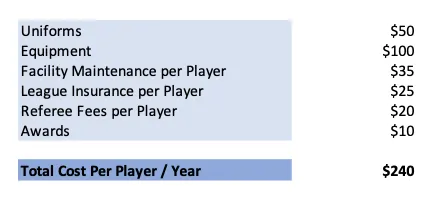
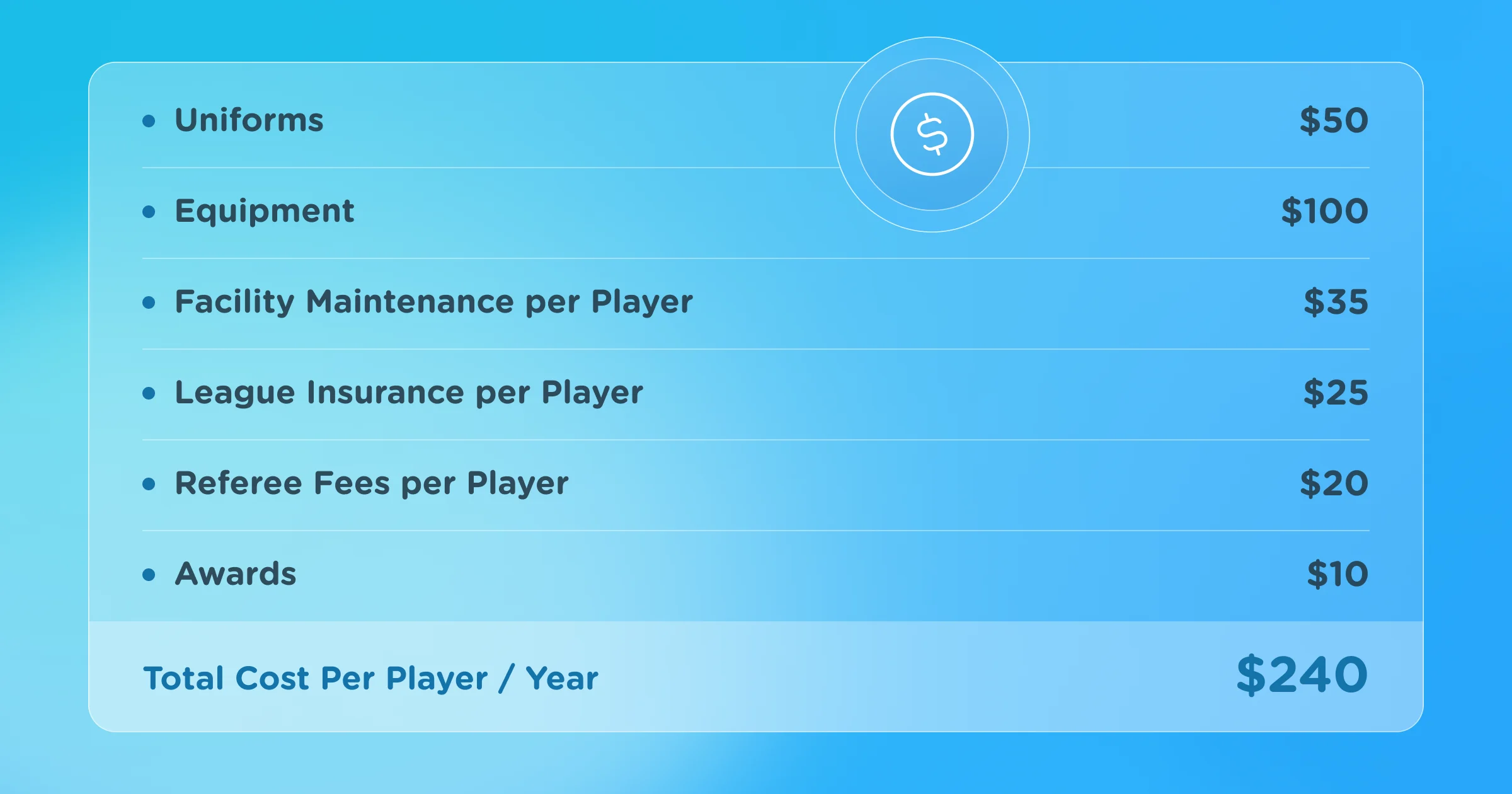
Figuring out the true cost to fund a player will help determine how much revenue your organization will need for your season.
Build your budget template
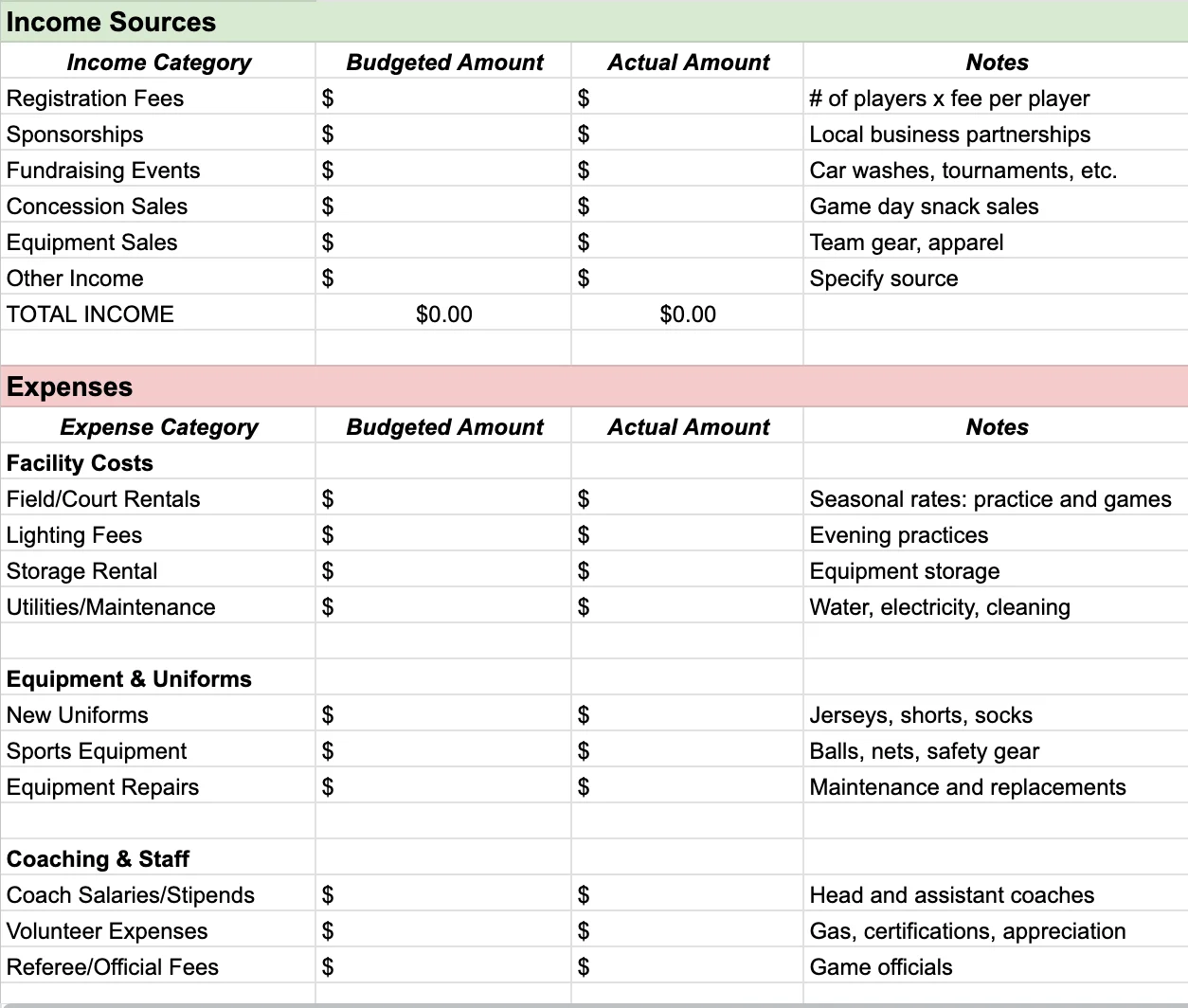
Keep your template simple and organized. Start with three sections: revenue, fixed costs, and variable costs. Then add columns to compare projected versus actual numbers as the season unfolds.
A shared Google Sheet works well here. Your board treasurer and league commissioner can both update it in real time, and everyone sees the latest numbers without digging through email threads.
Once you have the structure down, a sports club budget template gives you a ready-made starting point so you can get started faster.
Total up your organization's revenue
Give every revenue source its own line item: registration fees, concessions, donations, sponsorships, apparel, and fundraisers. Track each source separately.
A softball league that separates apparel sales from fundraiser revenue can immediately see which revenue streams are helping cover costs and which aren’t.
Online registration platforms can surface this data automatically, reducing the need for manual tracking.
Calculate your fixed and variable costs
Sort every expense into one of two columns in your spreadsheet: fixed or variable.
Fixed costs, like insurance and field permits, stay roughly the same whether you have 80 players or 120. Variable costs, like uniforms, tournament fees, and referee pay, rise and fall with enrollment.
This split lets you set a baseline budget and adjust registration fees more accurately as signups change.
Strengthen your budget with fundraising
Fundraising gives your league breathing room, helping keep registration fees manageable even when expenses rise.
Before your season opens, decide on one or two fundraising efforts: a local business sponsorship, a small community donation drive, or a sponsor-a-player program where community members cover registration costs for a family who needs assistance.
One small league used community donations to keep fees steady, helping to keep the season accessible to every youth athlete who wanted to play.
Add donations and sponsorships to registration
The easiest fundraising ask often happens when someone is already taking action. Adding an optional donation directly to your registration form means families can give right at checkout.
Offer simple tiers like $10, $25, or sponsor-a-player so supporters can choose what fits their budget.
More opportunities to give can lead to more support, and the ask happens automatically.
Track your budget year-over-year
One season of financial data is useful. Three seasons can be a planning advantage.
Imagine your club comparing registration income, fundraising totals, and uniform costs across three years. You can explain at a board meeting exactly why fees need to be adjusted, backed up by real numbers.
A simple spreadsheet works well for most volunteer-run leagues. Dedicated accounting tools are often unnecessary for a rec league with one treasurer.
Our guide to youth sports team accounting walks through practical ways to organize your finances so you have a solid head start on next season's budget.
Record variances after each season
A budget variance is the difference between what you planned to spend and what you actually spent. After the season closes, review every major line item and note where estimates were missed.
For example, you might budget $2,000 for uniforms but end up spending $2,400 after late registrations and jersey replacements. Logging that $400 difference now makes next year's estimate more accurate.
Choose the right tracking tools for you
Match your tools to your league's size. A 75-player rec league can run smoothly on a shared spreadsheet or a platform like Jersey Watch, which keeps payments and reports in one place.
An 800-player club with complex expenses may benefit from dedicated accounting software like QuickBooks or Xero.
Start simple, then scale up only if your current system creates extra work.
A solid budget means more game time
Budgeting doesn’t have to be complicated. Start with last season’s numbers, account for major expenses, and track your results as the season progresses. Over time, those records become one of the most valuable planning tools your organization has.
Jersey Watch helps leagues manage registration, collect payments, and keep financial records organized in one place. With fewer spreadsheets and less manual tracking, volunteers can spend less time on administrative work and more time supporting players, coaches, and families.
Try Jersey Watch for free and simplify how your league handles money.
FAQs
How do you create a budget for a youth sports league?
Start by pulling your financial records from the previous season before registration opens. List all projected expenses, categorize them as fixed or variable, then total your expected revenue sources, including fees, donations, and sponsorships. This gives volunteers a practical starting point for building a budget.
How do you calculate the true cost per player in youth sports?
Add up all projected season expenses, including fixed costs like insurance and field permits and variable costs like uniforms and tournament fees, then divide that total by the expected number of registered players. That number becomes the baseline for setting registration fees.
How should a league set registration fees without pricing families out?
Use cost per player as the starting point, subtract expected fundraising or sponsorship revenue, and set fees to cover only what remains. Building in a small reserve can also help protect the program from unexpected costs.
What expenses should be included in a youth sports budget?
Include fixed costs such as liability insurance, field or facility permits, website and registration software, and other recurring expenses. Then add variable costs such as uniforms, medals, tournament entry fees, and equipment. Tracking both categories separately can help leagues spot savings opportunities before the season starts.
What is the best way to track youth sports payments and fundraising in one place?
Collecting registration fees, donations, and sponsorship payments through a single online platform can reduce manual reconciliation and create cleaner financial data season to season. Many volunteer-run leagues can manage this with a well-structured spreadsheet or an integrated platform like Jersey Watch.

Tim GusweilerCo-Founder / CEO
Tim is the Co-Founder of Jersey Watch, where he works with the product, marketing, and customer support teams to build software for youth sports organizations. He writes about youth sports management based on years of experience working with league administrators, coaches, and volunteers, along with a lifelong passion for sports.


