

Running a youth league on a shoestring budget means every dollar counts, and sponsorships can be one of the most reliable ways to close the gap between what registration fees cover and what your season costs.
But a lot of volunteer-run leagues leave that money on the table simply because they're not sure how to ask for financial support, who to approach, or what to offer in return.
Looking at real sports sponsorship examples can change that. When you see what other local leagues are offering (tiered packages, jersey logos, sponsor pages on their website), it gets a lot easier to picture what your own program could put together.
This post walks through practical examples of what works, from small business partnerships and in-kind deals to grant programs your league might qualify for right now. You'll come away with a clear picture of what to offer sponsors, how to price it, and how to make the conversation feel natural instead of awkward.

What sports sponsorship means
Sponsorship is a trade. A local business gives your league money or gear, and your league gives them visibility in front of your community. A candy shop sponsors a rec league and gets their logo on jerseys and a banner at games. That's the deal.
The framing matters more than most leagues realize. Walk into a business asking for a donation and you're asking them to give something away. Walk in with a sponsorship offer and you're selling them something: access to 200 local families who show up every weekend. Those are two very different conversations.
Financial sponsorship: cash in exchange for visibility
Financial sponsorship is simple: a local business pays your league cash, and you give them defined visibility in return. A hardware store might pay $500 to have their logo on jerseys all season.
When you approach a business, come with a specific request: a dollar amount and exactly what they'll get. "We'd love your support" is too vague and doesn’t require action. "We're offering a $500 Silver sponsorship that includes your logo on game-day banners and a listing on our league website all season" closes deals. The more specific your offer, the less mental labor you're asking the business owner to do.
In-kind sponsorship: gear, food, and services
In-kind sponsors donate goods or services instead of cash, and they're often easier to land than cash sponsors.
A local print shop might cover your banner costs. A pizza place could provide end-of-season team meals. No check required.
This works well because you're asking for something the business already has at cost, not retail. A print shop printing your banner isn't giving away $300; they're giving away $40 in materials and an hour of press time. Start your in-kind list by writing down every vendor you already pay during the season, then approach those same vendors first — the relationship is already warm.
Local business sponsorship examples
Start with businesses that already serve your families. A local ice cream place, dentist, or hardware store wants visibility with the same parents filling your bleachers every weekend.
Give sponsors real placement options:
- Jersey patches or sleeve logos
- Dugout or outfield banners
- Field signage
- Postseason program recognition
- A sponsor spotlight on your league website
Before your first conversation, walk through your season and list every spot where a logo could appear. That inventory becomes your sponsorship pitch.
Small businesses that are natural fits
Start with businesses your families already visit. The audience fit is obvious, and a warm introduction from a parent or board member beats a cold call every time.
- Pizza restaurants: families are already regulars; a banner sponsorship is easy to pitch
- Orthodontists: high visibility with exactly the right age group
- Local gyms: naturally aligned with health and youth activity
- Sporting goods stores: may trade gear or discounts for logo placement
The best prospect list doesn't come from a Google search. It comes from your own registration form. Ask families to name two or three local businesses they use regularly, then cross-reference that list against who might benefit from being in front of your community. A business that already has 15 families as customers doesn't need convincing that your audience is relevant.
Once you have your prospect list, our guide on how to approach local businesses for sponsorship can give you the tools you need to have confident, positive sponsorship conversations.
💡Pro tip: If you’re reaching out via letter or email, check out these sponsorship letter examples for inspiration.
What sponsors get in return
Sponsors are buying visibility and community goodwill. When you frame it that way, the conversation gets a lot easier.
Be specific about what they're getting. Tell them: 200+ families see your logo at weekly home games, plus your business name appears on our league website all season long.
The mistake most leagues make is listing placements without connecting them to reach. "Logo on our homepage" means more when it's "Logo on our homepage, which 800 families visit every season to check schedules and register."
Numbers don't have to be precise to be persuasive. An honest estimate of your weekly attendance, your registration count, or your website traffic turns a vague offer into a real one.
Break it down like this:
- Logo placement on game-day signage
- A dedicated spot on your league website
- Social media mentions throughout the season
Digital placements sponsors value
Field banners are great, but digital placements give sponsors visibility all year, not just on game days.
A QR code on a field banner that links to a sponsor's offer or your league's sponsor page is a simple upgrade that makes every banner more valuable. Parents scan it, the sponsor gets traffic, and you look organized.
Online, your best options are a dedicated sponsor page, a logo grid on your homepage, or a linked feature spot that stays live through the off-season. These placements cost you nothing extra to maintain and give sponsors a reason to come back next year.
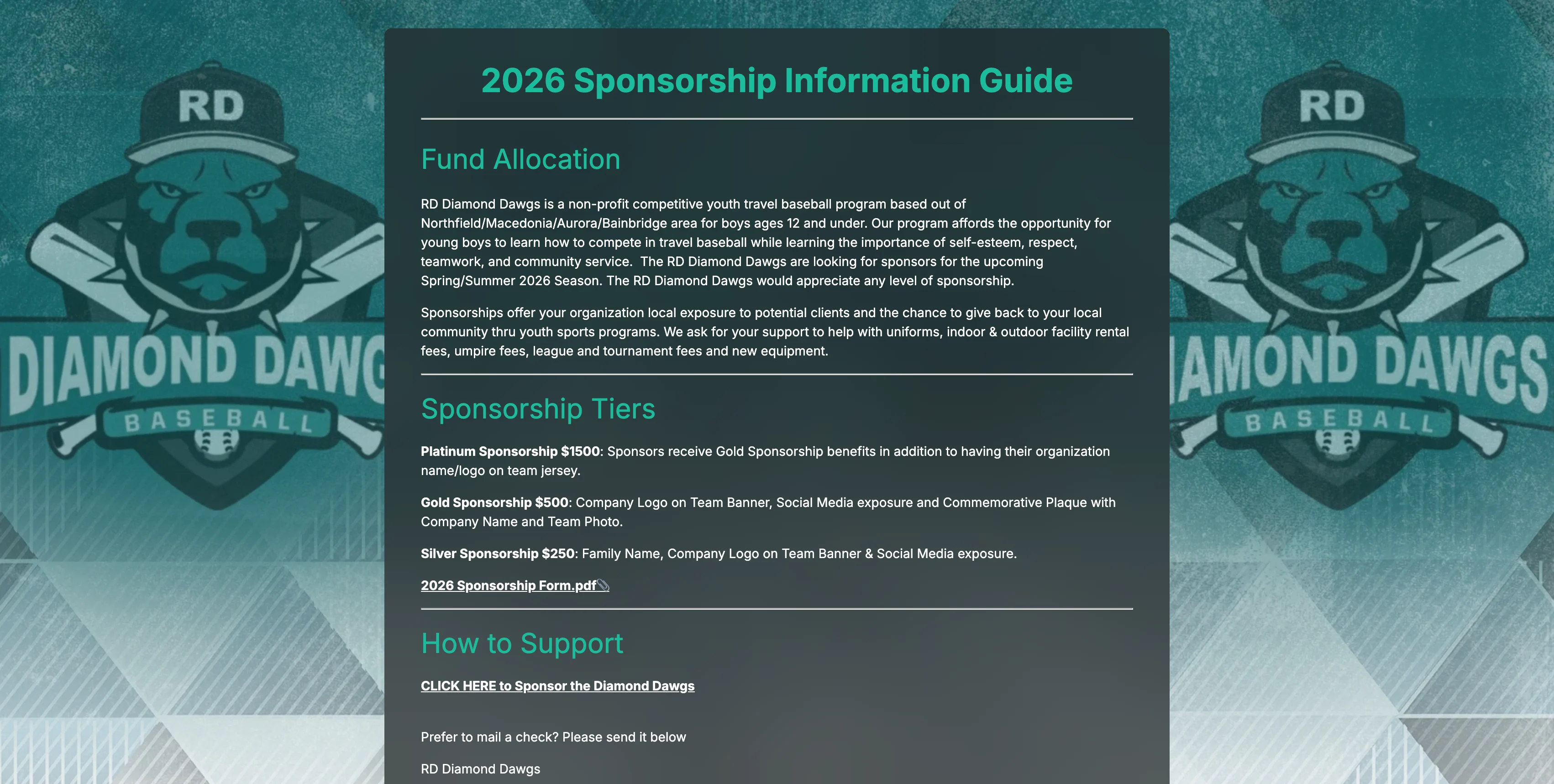
Tiered sponsorship package examples
Offering sponsorship tiers makes it easier for businesses of any size to say yes. A tiered package removes the guesswork and gives sponsors a clear, structured offer to evaluate.
Keep your tiers short and publish them in one place so businesses can decide fast. Four levels works well:
- Player Sponsor ($50–$100): Name in the program, great for individuals helping with registration assistance
- Bronze ($250): Logo on team page, social shoutout
- Silver ($500): Banner at games, website listing
- Gold ($1,000): Jersey logo, featured sponsor placement
Player sponsor: individual-level support
A Player Sponsor tier sits below Bronze, typically priced between $50 and $100, and it's designed for individuals rather than businesses. Think parents, grandparents, or community members who want to contribute beyond their registration fee without committing to a full business sponsorship.
This tier works well because it feels personal in a way that a corporate sponsorship doesn't. Someone sponsoring a player is making a direct, human contribution to a kid's season, and leagues can lean into that by pricing the tier to match exactly what one athlete's registration costs. A $75 player sponsor covers one kid's fees. That connection between the gift and the outcome makes it a much easier yes than an abstract dollar amount.
Recognition at this level is simple: a name listing in the season program or on a dedicated sponsor section of your league website. It's a low-lift ask with a meaningful return for the person giving it.
Bronze tier: entry-level visibility
A Bronze tier is your lowest barrier to entry, typically priced between $250 and $500 for a season. Sponsors at this level usually get a logo on your league website and a shoutout on social media — small but real exposure.
Think of the neighborhood barber shop or local auto repair place that's curious about sponsorship but not ready to commit big. Bronze gives them a low-risk first season to see if it's worth it.
Silver tier: mid-level visibility and recognition
Silver sits around $500–$750 and should feel like a clear step up, beyond just a higher price tag. Think logo placement on game-day banners, two or three social media shoutouts during the season, and a featured spot on your homepage instead of a buried footer logo.
A dental practice that started with a basic website logo, for example, becomes a homepage sponsor with banner visibility, a difference families notice. When upgrading a sponsor, increase their visibility first. The price increase follows naturally.
Gold tier: premium partnership benefits
Gold is your top tier, priced around $1,000–$1,500, and it should feel like a real partnership. Think jersey logo, a banner at every home game, and featured placement on your league website.
Keep this tier small. Exclusivity is what makes it worth the investment for a local bank, orthodontist, or regional business. When Gold sponsors feel genuinely valued, they renew. That's how a one-season deal becomes a multi-year relationship.
Youth sports sponsorship grant examples
Some of the best funding for youth leagues doesn't come from a sales pitch at all. Grant programs from national brands and foundations exist specifically to support organizations like yours. Programs like Dick's Sporting Goods Sports Matter and Nike community grants exist for youth sports teams, and you can apply directly.
Before you start, confirm your nonprofit or school eligibility. Then keep a simple list of needs: equipment, uniforms, or fee assistance. A league that can't land a local cash sponsor can still win equipment support through a grant.
Dick's Sporting Goods Sports Matter program
Grants range from $1,000 to $25,000 and can cover equipment, registration fees, and field costs, making this a strong fit for rec leagues stretched thin on basics. A recreational soccer league offering registration scholarships to lower-income families could use this grant to fund exactly that.
Eligible applicants must be 501(c)(3) nonprofits or public/charter schools serving communities with demonstrated economic need. Interested parties need to fill out their form, then be invited to apply.
Good Sports equipment grants
Good Sports is a national nonprofit that ships equipment, apparel, and footwear directly to youth sports organizations serving kids in financial need. No cash grant required. A football program short on helmets or a baseball league needing balls and cleats can apply on a rolling basis at goodsports.org.
One thing worth knowing: Good Sports ships from available inventory, so what you get depends on what they have. Apply as soon as a specific gear gap opens up, and be specific about what you need. A vague request for "equipment" is less likely to get filled than a request for "12 youth batting helmets, sizes 6.5–7."
What big-brand deals teach small leagues
You don't need a Nike budget to borrow from Nike's playbook. The principles behind big-brand sponsorships, audience fit, activation, and clear value exchange, translate directly to local partnerships.
Nike and Red Bull don't win sponsorships with bigger checks. They win with better audience alignment and smart activation. Your 300-kid rec league can borrow both principles.
Audience alignment means matching a sponsor's goals to your families. A local gym cares about health-conscious parents. That's your crowd. A pediatric dentist cares about kids ages 5–14. That's your roster. When you walk into a sponsorship conversation already knowing why your audience is the right audience for that business, you've done the work they'd otherwise have to do themselves.
Activation means making the partnership visible. Give that gym a field banner and a social shoutout after game day. Now they see real value beyond a logo placement.
Copy the principle, not the scale. Small and specific beats big and generic every time.
Measuring whether your sponsorship worked
Sponsors renew when they see results. Even simple numbers make a strong case for next season. At the end of the season, send a short recap email. Include four things:
- Banner placements, jersey logos, and homepage impressions
- Home game attendance and event turnout
- Estimated reach based on your registration numbers
- A quick note on how the partnership went
Add digital metrics, too. Pull your sponsor page visits and social media reach from the season. A quick line like "Your logo appeared on our homepage, which received 1,200 visits this fall" gives them something concrete to point to.
Most leagues skip the recap entirely, which means sponsors have nothing to show internally when someone asks whether the sponsorship was worth it. A one-page summary sent within two weeks of your last game could be the difference between a sponsor who renews automatically and one who forgets to follow up. Jersey Watch makes it easy to feature sponsors directly on your league website, so those impressions are real and trackable.
Ready to build a package worth presenting? Start with a solid youth sports sponsorship package.
Your league website is your best sponsorship tool
A clean, professional website makes sponsors take you seriously before you ever get on a phone call. A local business owner who gets your outreach email clicks your link and lands on a page showing your sponsorship tiers, contact info, and current sponsor logos, all in one place. That single moment builds more credibility than any pitch.
Put your sponsor information where it's easy to find: a dedicated sponsor page, a homepage feature, and a simple contact form for interested businesses. Jersey Watch's website builder lets you set up exactly that kind of page without any technical experience needed. You can display sponsor logos, outline your packages, and give businesses a clear next step.
When your website looks organized and welcoming, sponsors see a league worth investing in. That's what turns a cold email into a signed deal.
Get started with Jersey Watch for free and build a site your sponsors will be proud to appear on.
FAQs
What are some good sports sponsorship examples for a local youth league?
Local restaurants, orthodontists, gyms, and hardware stores are natural fits because they already serve league families. Logo placement on jerseys, banners, and the league website creates direct visibility, and in-kind sponsors like a print shop donating banners can be just as helpful as cash sponsors.
What should a team offer a sponsor in return?
Sponsors expect visibility. Common deliverables include jersey logos, a dedicated sponsor page on the league website, game-day banners, and social media shoutouts. Digital placements can keep working year-round.
How do you create a sponsorship package for a youth sports organization?
Build a tiered package with Bronze, Silver, and Gold levels, each with a clear price and listed benefits. A one-page overview with team size, season dates, and contact info is often enough to start the conversation.
How do you get sponsors for a sports team or club?
Start with businesses families already use and ask families during registration for favorite local shops or service providers to surface warm prospects. A professional league website with a visible sponsorship page can help close more deals.
How do you measure whether a sports sponsorship was successful?
Track simple metrics such as sponsor page visits, game-day attendance, and social media reach from sponsor shoutouts. Sharing these numbers at season's end helps sponsors see value and makes renewal more likely.

Tim GusweilerCo-Founder / CEO
Tim is the Co-Founder of Jersey Watch, where he works with the product, marketing, and customer support teams to build software for youth sports organizations. He writes about youth sports management based on years of experience working with league administrators, coaches, and volunteers, along with a lifelong passion for sports.


