
Table of Contents
You've got a gym in mind, a group of kids who are ready to compete, and a real desire to build something lasting in your community. Now you need to know how to start an Amateur Athletic Union (AAU) basketball team and do it right the first time.
Starting an AAU basketball team means forming a youth travel basketball program that meets AAU’s membership, insurance, and coach-screening requirements before you recruit players, hold tryouts, or enter sanctioned events. It also means sorting out your club setup, budget, practice space, roster, and parent communication before the season begins.
That can seem like a lot. But none of it is out of reach for a volunteer organizer running a first-year program on a tight budget and a packed schedule.
This guide walks you through each step in the right order, from registering with AAU and screening your coaches to planning tryouts, setting your budget, and keeping families in the loop all season long.

What are AAU's membership and insurance rules?
AAU compliance comes before recruiting players or booking a gym. Individual adults must be registered correctly first. If you're launching a first-year 13U boys team, skipping this step can delay spring tryouts by weeks. Register yourself and any coaches as non-athlete members, then handle club registration, in that order.
Why should you purchase non-athlete memberships first?
AAU requires club contacts and coaches to hold active non-athlete memberships before a club can register, so this step comes first.
The official sequence on AAU's join page is straightforward:
- Every adult, club contact, and coach, buys a non-athlete membership.
- Confirm those memberships are active.
- Then complete club registration.
Say you're a parent running a single 12U team with one head coach and one assistant. All three adults purchase non-athlete memberships first. Once confirmed, club registration opens up.
How do you register your club and secure insurance?
Once adult memberships are active, register your club through AAU's national platform and secure insurance before booking any gym time.
Before paying a deposit, confirm your club level, participant count, and what proof of coverage the facility requires.
For example, a small nonprofit renting a school gym may need to show a certificate of insurance before court time is approved. Getting that documentation in order early prevents delays that can push back your entire first season.
How should you choose your program's philosophy and division?
Lock in your philosophy and age division before tryouts, because these decisions shape everything else. A single 12U development team has different roster needs, practice demands, and event choices than a multi-age travel club chasing competitive exposure.
Need more guidance? Check out how to start a travel baseball team or how to start a travel softball team for similar setups.
Should your team emphasize competitive or participation play?
Your answer shapes everything, including practice frequency, travel distance, and the type of player you recruit.
A fifth-grade development team might practice twice a week and play local tournaments, keeping costs manageable for families. A high school team chasing stronger tournament exposure may travel regionally, practice four days a week, and evaluate players on skill ceiling, not just effort.
✅ Do this now: Write one sentence describing your program's purpose and your target age division before you announce tryouts.
What is the difference between an AAU club and an independent travel team?
An official AAU club follows AAU's membership, insurance, and sanctioning requirements. An independent travel team sets its own rules, even if everyone casually calls it "AAU."
This distinction matters more than most people realize. A volunteer might say, "I want to start an AAU team," but envision multiple age groups, local games, and a full bracket of teams. That's a community league, not a single club.
If that sounds like your situation, check out this guide on how to create a basketball league before committing to the AAU club structure.
👀 Quick rule of thumb: One team competing in outside tournaments equals a club. Multiple teams playing each other equals a league.
How do you build an AAU team brand and website?
Families decide whether to trust a new club before they ever attend a tryout. A simple name, a working website, and clear tryout details signal that your program is real. Think of a new 14U club posting coaching bios, its mission, tryout dates, and fee details in one place, giving it instant credibility.
How should you design a logo and team identity?
Pick your team name and two consistent colors before you create any social accounts or order uniforms. A short, city-based name helps families find you online quickly.
For example, a 14U girls club in Austin might choose "Austin Rise 14U." It’s easy to search, easy to remember, and immediately local.
Keep your mascot age-appropriate and simple enough to work on a jersey. Jersey Watch includes website design help with every plan, so your brand looks polished from day one.
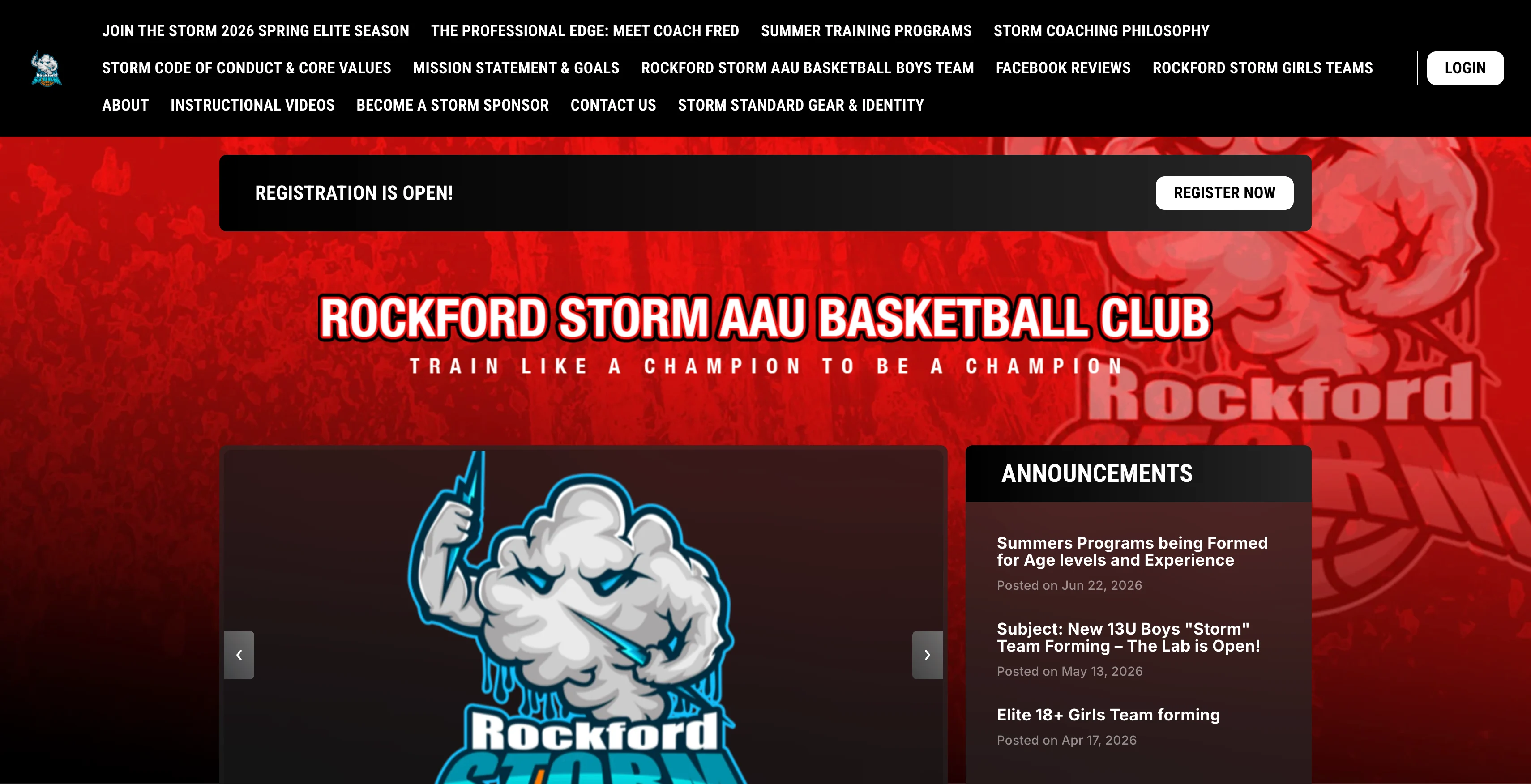
An AAU youth basketball club website built using Jersey Watch
How do you set up online registration and payments?
Moving registration online replaces paper forms, cash at the door, and scattered text threads with a single, clean process that families can complete on their phones.
Your website should collect everything in one place: tryout sign-ups, player contact info, signed waivers, jersey sizes, and fees.
Think about what that saves on tryout day. Instead of a commissioner juggling a cash box and a clipboard at the check-in table, every tryout fee and jersey size is already logged before the first player walks through the door.
Collect these items online before tryouts open:
- Player contact information
- Signed waivers
- Tryout fees
- Jersey sizes
How do you recruit coaches and hold AAU tryouts?
A first-year club typically needs a head coach, assistant, and a handful of committed players. Here’s how to recruit safely and successfully finalize your player roster.
How do you complete required background screening?
Every adult working with your team should be screened before the first practice, no exceptions. For each coach, confirm three things before sharing the roster with families:
- Background check completed
- Safety education course finished
- Conduct policy signed
One simple spreadsheet makes this manageable. A board member can list every adult, mark each column when cleared, and hold the roster until every row is complete.
Families trust your program when they know you verified every adult before the season started, not after.
How should you finalize your roster after tryouts?
Aim for 8–10 committed players plus two alternates. That gives you enough depth without overcomplicating rotations.
Run two tryout sessions and score each player across five areas:
- Ball-handling
- Defense
- Effort
- Coachability
- Attendance commitment
Written scores make the final cuts easier to defend and keep emotions out of tough decisions.
When you contact families, be direct and kind. Tell selected players their spot is confirmed and what comes next. For players who didn't make it, a brief, respectful message goes a long way toward keeping goodwill in your community.
How do you plan practices, facilities, and player development?
Gym access drives everything. If your rec center only opens courts two evenings a week, those two nights become your entire development program, so plan around them deliberately.
Map each session to a specific skill focus before the season starts. That discipline protects your volunteers' time and gives players consistent, purposeful repetitions every week.
How do you build a schedule that protects rest?
Rest belongs in your schedule just as much as practice does. USA Basketball's coaching resources emphasize recovery as a core part of player development, so don’t overlook it
A simple, sustainable rhythm looks like practice Tuesday and Thursday evenings and one weekend tournament per month. That structure gives players two skill-building sessions each week, plus real recovery time before travel.
Avoid stacking back-to-back tournament weekends early in the season. Families burn out fast, and so do 12 year olds.
Map your full month before announcing the schedule. When families can see practice days, off days, and event weekends at once, they commit more confidently and miss fewer sessions.
How do you create a skill development strategy?
Match your development plan to your players' age and ability level. USA Basketball's player curriculum gives coaches clear, age-based skill benchmarks, so you're not guessing what to teach or when.
Start by mapping one monthly focus for each age group. A 10U team might spend four weeks on ball-handling. A 15U group is ready for decision-making, spacing, and reading defenses.
A coach working with younger players should dedicate most practice time to fundamentals, including dribbling, footwork, and passing. With high school athletes, that same coach can shift toward game concepts like pick-and-roll coverage and late-game situations.
📝 One immediate action: Write down one skill focus per age group before your first practice of the month. That single step keeps every session purposeful.
How should you set your tournament and event schedule?
Match your first season's events to your team's age group, travel range, and readiness. A nearby AAU district tournament is a smarter starting point than a national showcase, with lower cost, less travel stress, and more appropriate competition for a first-year squad. Start local, then grow from there.
How do you choose sanctioned events for your age division?
Picking the right events early keeps your first season affordable and compliant. Before registering for any tournament, run through this quick checklist:
- Sanctioning: Verify the event is AAU-sanctioned on the AAU website
- Age bracket: Confirm your division is offered
- Travel distance: Keep trips drivable for families
- Competition level: Match the field to your roster's readiness
- Registration deadlines: Mark them on your calendar early
A first-year 12U club, for example, might choose two nearby weekend events rather than chasing a national showcase across three states. That approach saves money, protects player energy, and gives your program a realistic foundation to build on.
What does a realistic AAU team budget include?
Before you announce dues, add up every fixed cost: AAU memberships, insurance, uniforms, gym rental, and event entry fees. A volunteer-run club that prices the season after opening registration often gets the math wrong. For a deeper breakdown of basketball program costs, check out this cost guide.
What should you budget for membership, insurance, and travel expenses?
Split your AAU budget into two clear buckets: fixed team costs and variable family travel costs.
A typical spring season for one team might look like:
- AAU memberships (adults + players): $200–$400
- Club insurance: $150–$300
- Uniforms: $400–$800
- Gym rental (12 practices): $600–$1,200
- Tournament entry fees (three events): $600–$900
That puts team registration fees somewhere between $200–$300 per player for a 10-player roster.
Families pay for their own hotel, gas, and meals. Be explicit about this before registration opens, so nobody is surprised by a $150 hotel bill on top of their dues.
Build your registration fee around fixed costs only, then send families a travel estimate so they can plan ahead.
How can you find sponsors and fundraising support?
Sponsorships and fundraising exist to make your program more affordable. Even one local sponsor can meaningfully lower what families pay at registration.
Start by drafting a one-page sponsor asking for a nearby restaurant or small business. Offer a jersey logo or banner at games in exchange for a flat contribution that offsets player dues.
A 3-on-3 tournament early in the season is another practical option. It builds community buzz and brings in funds before the season's biggest costs hit. For more ideas, check out this list of basketball fundraising ideas built specifically for teams like yours.
One sponsor plus one early fundraiser can make a real difference in who can afford to join your first-year team.
How do you promote a new AAU team and keep families engaged?
Promotion starts with making information easy to find, and trust comes from keeping it current all season long. Your website should be the first place families see tryout dates, practice locations, and fee details, since a clean, current page builds confidence before a parent even reaches out.
Once the season starts, communication matters as much as the launch. Keep these three habits in one place:
- Post tryout dates and updates on your website.
- Send schedule changes by text or email the moment they happen.
- Share tournament reminders with location details a few days before each event.
Families who stay informed stay engaged. Social media can spread the word early, but it should support your website, not replace it, since your site is the one place that stays organized and searchable no matter how old a post gets.
Once your roster is set, check out this guide on how to manage a basketball team for what comes next.
Getting your registration process figured out before you open signups matters most. Families who show up to tryouts without a clear way to pay, sign waivers, or get updates lose confidence fast, and that first impression is hard to walk back.
A platform like Jersey Watch brings registration, payment collection, background screening, and family communication into one place, so you're not stitching together a dozen tools mid-season.
Get started with Jersey Watch to build your team's website and launch registration, payments, and background screening with a plan built for volunteer-run programs.
FAQs
What do you need to start an AAU basketball team?
You need the right AAU memberships for your adult club contacts first, followed by club registration and proper insurance. After that, you need a coach, a committed group of players, practice space, and a clear way to handle tryouts, waivers, and fees. For most first-year teams, having about eight to 10 players and one organized place for family communication makes the launch much smoother.
How do you register a basketball team with AAU?
AAU registration starts with club contacts and coaches buying non-athlete memberships before the club itself can register. Once those memberships are active, you can complete the club membership process and confirm the insurance your team and facility need. Because fees and requirements can change from season to season, verify the current sequence directly on AAU's join page before you pay or announce tryouts.
Do AAU coaches need background checks or certifications?
AAU coaches are expected to complete safety education and follow conduct rules, and many programs also run background checks before the season begins. Even when a facility or local event has separate policies, screening every adult who works with players is a strong baseline for player safety and parent trust. Keeping a simple checklist or digital record helps make sure no coach is missed.
How much does it cost to start and run an AAU basketball team?
Starting and running an AAU basketball team usually means paying for memberships, insurance, uniforms, gym time, tournament entry fees, and travel. Travel and event costs often take the biggest share, but first-year organizers also need to budget for setup expenses that families may not expect right away. Many teams cover the full season through a mix of player dues, sponsors, and fundraising rather than relying on one source.
What is the difference between an AAU team and an independent travel basketball team?
An AAU team operates under official AAU membership, insurance, and event sanctioning rules, while an independent travel team sets its own structure and may play in non-AAU events. In everyday conversation, people often call any competitive travel basketball team AAU even when it is not officially sanctioned. The real difference comes down to how much formal oversight, eligibility structure, and AAU event access your program wants.

Nick RattermannCo-Founder / CTO
Nick Rattermann is the Chief Technology Officer at Jersey Watch with more than 10 years of experience building software for volunteer-run youth sports organizations. He writes about youth sports technology and league management, drawing on both his technical expertise and his experience as the parent of a son who plays soccer and basketball.


