
You've got a gym in mind, a handful of kids who want to play basketball, and a league that doesn't exist yet. So now comes the part nobody warned you about: figuring out what it's going to cost.
This breakdown walks through every major expense category, shows you a simple formula for setting registration fees that fit your budget, and offers a few practical ways to lower costs before families ever see a price tag.

What does it cost to start a basketball league?
Starting a recreational basketball league typically costs between $15,000 and $45,000 in year one. That range shifts based on league size, local facility rates, whether you rely on volunteer or paid staff, and the number of separate tools you use to manage registration and communication.
A small four-team rec league using volunteer coaches and a school gym will be much closer to $15,000. A larger program paying for premium gym time and hired staff can be closer to the top of that range.
Before locking in your season format or registration price, start a simple budget spreadsheet and map out every expected expense first.
How league size changes your total budget
Not all costs grow with your roster. Fixed costs like insurance and league software stay roughly the same whether you have four teams or 12. Variable costs (think uniforms and referee pay) rise with every team and player added.
Before setting fees, separate your budget into these two buckets. A larger league spreads fixed costs across more players, lowering the per-player cost, while variable costs increase with participation.
Take court rental as an example:
- A 4-team league with around 96 hours of court time needs roughly $4,800 at $50 per hour.
- An 8-team league running 192 hours of court time costs about $9,600.
- A 12-team league with 288 hours of court time needs around $14,400.
Insurance tells a different story. A fixed premium in the $500–$2,000 range stays about the same whether you're splitting it across four teams or 12, so the per-team share drops as your league grows.
First-year costs vs. ongoing season costs
Not every expense repeats. Before you set registration fees, split your budget into two columns: startup costs (one-time) and recurring costs (every season).
- One-time: Scoreboard, incorporation fees
- Recurring: Court rental, insurance, referee pay, software
Mark every purchase you can reuse next season. That tells you what year-one registration fees must cover, and keeps you from overcharging families for costs that won't come back.
Breaking down every major expense
Court rental will likely be your biggest single line item, but it's not the only cost worth scrutinizing. Equipment, referees, insurance, software, and admin work all add up fast. Understanding how much each category typically costs helps you spot where you can negotiate, where you can delay spending, and where you need to budget full price.
Court rental
Court rental is almost always the biggest line item in a basketball league budget, so your hour count matters more than any other estimate you make.
Work through the math before you call any facility. Take an eight-team league running a 12-week season with four games per week. That's 192 total hours of court time. At $50 per hour, a reasonable starting point in many markets, you're looking at $9,600 just for games. Practices can add significantly more.
Calculate game hours and practice hours separately, then bring both numbers when asking facilities for quotes. Rates vary widely by location, so always confirm locally.
Private courts tend to run higher. School gyms, church facilities, and municipal recreation centers are often meaningfully cheaper and worth contacting first. Ask each venue for their hourly rate, seasonal package options, and whether they require proof of insurance before booking.
Equipment and awards
Equipment costs are easy to underestimate, so split your list into two groups before you spend anything: must-haves for opening day and nice-to-haves you can delay.
A first-year rec league needs basketballs ($30–$70 each), uniforms ($30–$60 per player), whistles, and first aid kits. That covers opening day.
Scoreboards ($1,000–$3,000) and shot clocks ($200–$1,000 per pair) can wait until the budget is stable. The same goes for trophies. For a 10-team league, basic awards typically run $500 to $1,500, so keep it simple in year one and upgrade later once registration revenue proves out.
Buying essentials first keeps startup costs predictable and gives you room to add extras once the league finds its footing.
Referees and coaches for rec leagues vs. competitive programs
Referee fees typically run $25 to $50 per game, per official, depending on experience level and your league's competitiveness. Most games need two officials, so for a season with 10 teams playing 18 games each, referee costs can total $4,500 to $13,500.
Budget for referees, but don't automatically budget for paid coaches. For most recreational leagues, parent volunteers handle coaching, and that's completely normal.
A parent-volunteer rec league can run just fine without a coaching budget. A select-style program, however, may need experienced paid coaches to meet competitive expectations.
Decide early which model fits your program. If you're building a rec league, leave paid coaching off the year-one budget entirely. If you're moving toward a more competitive format, add it as a line item before registration opens.
Insurance and admin costs: Required basics vs. optional staffing
Some costs are non-negotiable from day one. General liability insurance typically runs $500 to $2,000 per year for a recreational league, and most facilities won't let you rent court time without proof of coverage, so get that lined up early.
Beyond insurance, budget for incorporation fees ($100–$800) and business licenses ($50–$400 annually). These belong in every first-year budget regardless of league size.
A part-time administrator runs $10,000–$20,000 per year, and most small volunteer leagues skip it. Budget for required paperwork and protection first, then decide whether you need paid help. If you're running a recreational sports league with a solid volunteer base, paid admin is usually the last thing you need in year one.
Marketing, website, and software
Website, registration, payments, and communication don't have to be four separate budget lines. Bundling them on one platform often costs less than piecing tools together.
Before choosing any system, add up what you'd otherwise pay separately: basic website hosting, an online form tool, a payment processor, and a parent messaging app. That total adds up fast for a volunteer-run league.
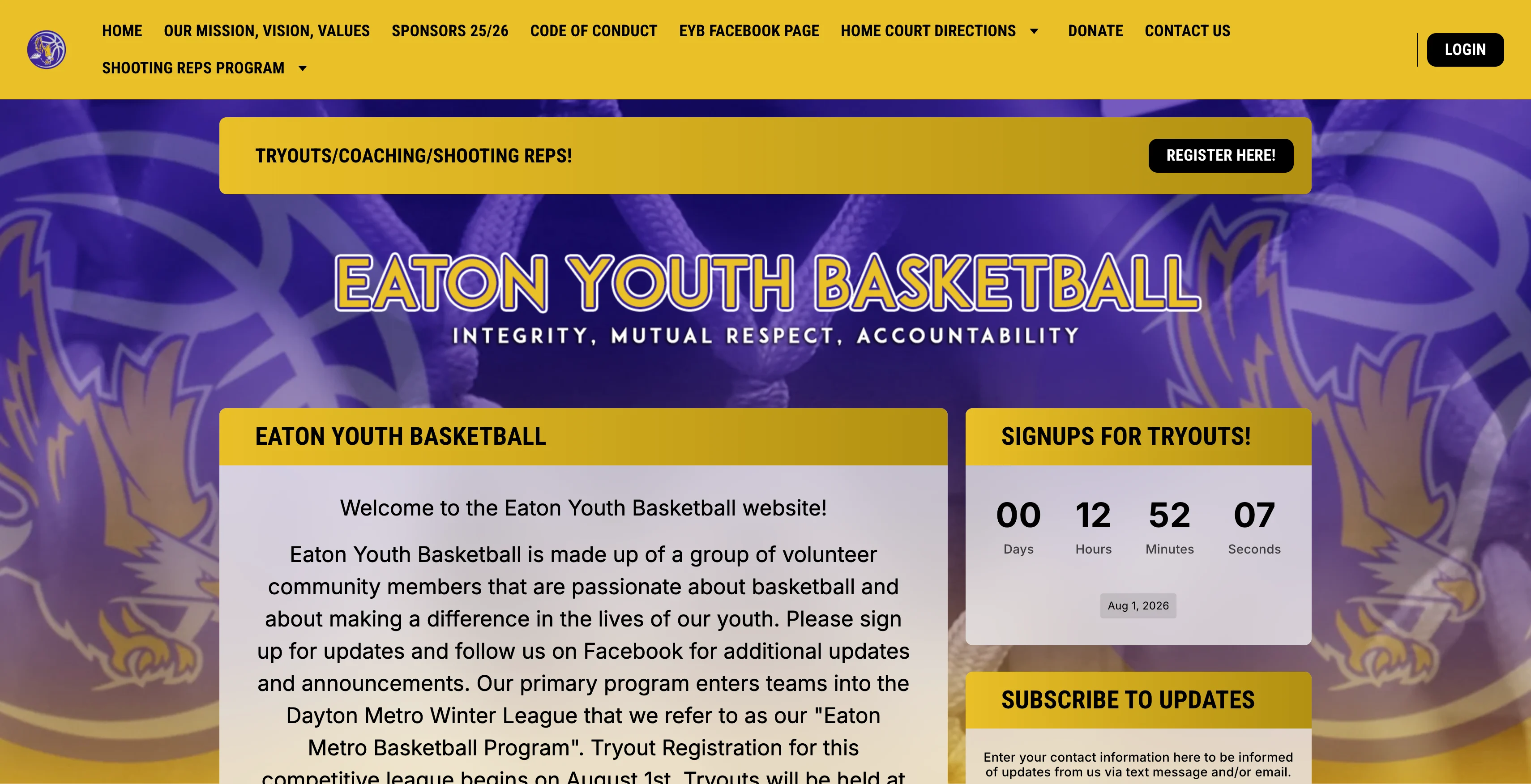
A youth basketball league website built on Jersey Watch
A rec league replacing a standalone website, email tool, text tool, and paper registration process with one platform cuts both monthly costs and admin headaches at once.
With Jersey Watch, create your account for free to explore all of the features. When you're ready to launch, get your first month for just $19, including full-service website and online registration setup from their team. After the first month, pay $348 to keep your website and registration for the year.
How to set your registration fees
Once you've estimated your total expenses, the next step is simple arithmetic. A formula divides those costs across your expected player count to give you a break-even fee, the minimum registration price your league needs to charge. From there, you can adjust for payment processing, sponsorships, and fundraising before families ever see the final number.
A simple break-even formula
Your registration fee is calculated as the total projected costs divided by the expected player count.
- Add up all projected costs for the season.
- Estimate your player count.
- Divide costs by players to find your break-even fee.
- Adjust down once you factor in sponsorships or fundraising.
Start here before you debate early-bird discounts or sibling deals. Get the break-even number on paper first.
For example: $15,000 in projected costs divided by 100 players equals a $150 break-even fee. If a local sponsor covers $1,500, that number drops to $135 per player.
That's real savings families will notice, and it comes from planning, not guessing.
Once you've got your break-even number, create your free Jersey Watch account to set up online registration and start collecting fees as soon as the season opens.
Factoring in payment processing fees
Online registration saves time, but payment processing fees reduce what your league keeps from each registration. That’s just the cost of doing business online so build that into your pricing before you go live.
Calculate your net revenue first. At a typical rate of 3.5% plus $1 per transaction, a $75 registration fee nets roughly $71.37 after processing. Multiply that gap across 100 players, and you're short about $362.
Price for what you net, not what you charge.
Ways to lower your startup costs before opening registration
Before you lock in a registration fee or sign a facility contract, there are three concrete moves that cut costs significantly. The best part: all three happen before the season starts, which means families see lower fees at signup instead of paying full price and hoping for refunds later.
Use school gyms and rec centers
Public school gyms and municipal rec centers are often the fastest way to cut facility costs before your first season starts. Saint Paul's public rec centers charge $35 to $55 per hour for indoor gym space, well below many private facilities. Rates vary, so verify pricing in your city.
Start by building a simple spreadsheet listing school athletic directors, church offices, and parks-and-rec contacts. Ask each one for their hourly rate, insurance requirements, seasonal packages, and whether the space is available for both practices and games. Then compare and choose.
Start with volunteer coaches
Volunteer coaches can eliminate a significant budget line without hurting your players' experience. During registration, ask parents to sign up as head coach or assistant for their child's team. Local college students studying education or kinesiology are another great option.
A small rec league can assign one parent head coach and one assistant to every team, then revisit paid coaching only after the program grows.
Bundle your website and registration tools
Before approving any subscriptions, audit every separate tool you're considering: website host, registration forms, payment processor, and team messaging. A volunteer board replacing all of them with one platform saves money and hours every week.
Tips for making money as a basketball league without raising fees
Three revenue streams stand out as easy wins: local sponsorships, special events, and merchandise sales. Each one works independently, so you can pick one, two, or all three depending on your volunteer bandwidth. The key is planning them before registration opens so you can price fees lower from day one instead of scrambling for money mid-season.
Get local businesses to sponsor your league
Even one or two local sponsors can cover meaningful fixed costs and bring registration fees down for every family.
When you approach a restaurant, bank, or insurance office, show them exactly what they get: jersey logo placement, a banner at games, or a listing on your league website. Then show them how their support lowers costs for local families. That community angle matters to small businesses.
A single $500 sponsorship on a 100-player league saves every family $5 at checkout.
Run tournaments and special events
Weekend tournaments and holiday camps can bring in real money without touching your regular registration fees. Schedule them during school breaks or long weekends, when families are already available and courts are easier to book.
Pick events that match your volunteer bandwidth. A court-a-thon, charity game, or simple raffle takes far less coordination than a multi-day tournament. Even a one-day holiday camp can generate hundreds of dollars in extra revenue while giving kids more court time.
Sell league merch
Simple merch like t-shirts, hats, and water bottles brings in extra money while building real pride around your league. Sell online and at games to reach more families. It won't replace registration revenue, but it's an easy way to keep money coming in all season long.
Start your league without breaking the bank
Running a league on a tight budget takes real effort, and every dollar you save on admin tools is a dollar that stays in the program.
One practical move: replace separate website hosting, paper registration, and scattered parent texts with one affordable platform. Fewer tools means fewer bills and less volunteer time spent juggling logins.
Ready to simplify your operations? Get started free with Jersey Watch today.
FAQs
How much does it cost to start a youth basketball league?
Most new recreational basketball leagues spend between $15,000 and $45,000 in their first year. Court rental, referee fees, insurance, equipment, and basic admin tools usually make up most of that total. A smaller volunteer-run league using lower-cost gym space will land closer to the low end, while a larger program with paid staff or premium facilities will move higher.
What are the biggest expenses when starting a basketball league?
Court rental is usually the biggest expense for a new basketball league, especially if you need space for both games and practices across a full season. Referee pay, liability insurance, and equipment are the other major costs most leagues cannot skip. Staffing costs vary the most because many rec leagues rely on volunteer coaches and admin volunteers rather than paid staff.
What costs are one-time startup expenses versus recurring season expenses?
One-time startup expenses are the purchases or setup costs you pay once, such as a scoreboard, incorporation fees, or initial equipment purchases. Recurring season expenses are costs that recur each season, such as court rental, referee fees, insurance, and league software. Splitting those categories early makes it much easier to build a realistic first-year budget and avoid charging families for the wrong things.
How do you set basketball league registration fees so costs are covered?
Start with a simple break-even formula: divide your total projected expenses by the number of players you expect to register. That gives you a baseline fee before payment processing costs are applied, so you can see what the league needs to collect. If you expect sponsorships or fundraising income, subtract that support from the total budget before finalizing the fee so families are not covering more than necessary.
Do you need league management software to start a basketball league?
No, you do not need league management software on day one to open a basketball league. That said, software can replace several separate tasks and costs at once by consolidating your website, online registration, payment collection, and parent communication into a single platform. For volunteer-run leagues already trying to avoid paper forms and scattered tools, one platform can be simpler and sometimes cheaper than piecing those functions together separately.

Courtney CalvoCustomer Care Team Lead
Courtney Calvo is the Customer Care Team Lead at Jersey Watch, where she helps youth sports organizations get started with registration, websites, and league management tools. She brings both professional expertise supporting leagues and firsthand experience as the parent of a youth soccer player.


