
Looking for youth basketball drills for coaches? This guide shares 35 practical drills you can use in practice, including shooting, dribbling, passing, footwork, defense, offense, conditioning, individual work, and fun games.
In youth basketball and beyond, coaches can be just as important as the players on the team. From helping to form team chemistry, teaching the mechanics of the game, and motivating players, to forming and implementing a strategy, good coaches can be a true difference maker for your program.
When it comes to youth basketball drills, there are a few different types of drills you should implement into your program. Some help build team chemistry and teamwork, some help players work on individual skills, and some help with endurance during crunch time. In this post, you'll learn 35 basketball drills that beginner and veteran coaches can use to help their teams learn and succeed.

Shooting and layup drills
1. Spot shooting
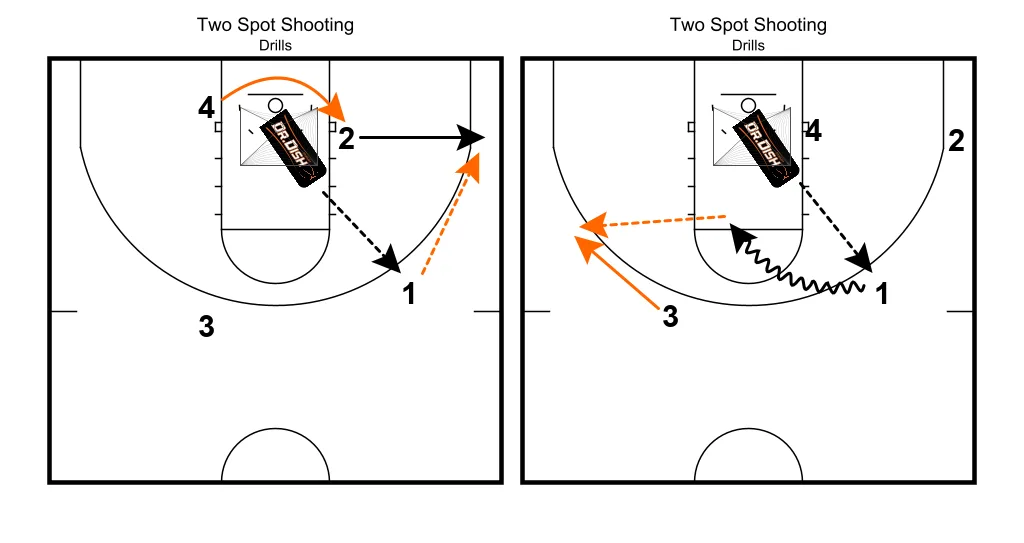
Source: Dr. Dish Basketball Blog
Players shoot from 5 key spots around the perimeter: both corners, both wings, and the top of the key. This drill helps players get comfortable with different angles of the court. It's essential to maintain proper form and technique at each spot. As players improve, introduce a timer or a defender to increase pressure.
2. Layup lines
Players form two lines at opposite wings of the court. One at a time, each player dribbles toward the basket, executing a layup. This drill works on the mechanics of a layup and on proper footwork and finishing with either hand. Over time, players can incorporate variations like reverse layups or euro steps.
3. Catch and shoot
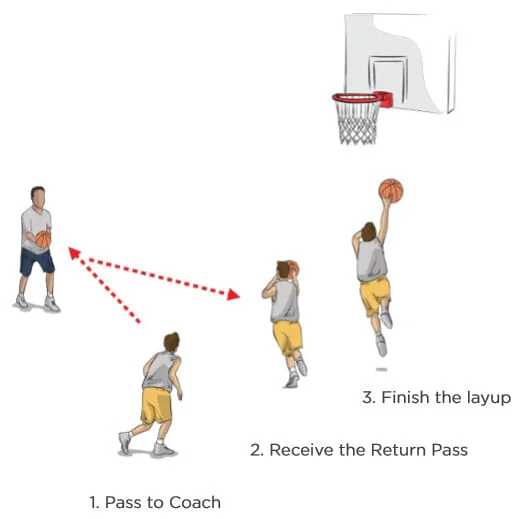
Source: Online Basketball Drills
A passer stands at the top of the key, while shooters line up at various spots around the court. The shooter runs to a spot, catches a pass from the basketball coach, and shoots immediately. This drill simulates game-like situations where players receive a pass and have to quickly set their feet and shoot.
4. Mikan drill
Named after George Mikan, a pioneering NBA player, this drill is done under the basket. Players make a layup on one side, rebound the ball on the opposite side, and then lay the ball up on that side, developing a rhythm.
This drill focuses on soft touches, ambidexterity, and efficient footwork close to the basket. Regular practice of the Mikan Drill helps players improve their finishing around the rim.
Basketball dribbling drills
5. Stationary dribble
Players stand in a spot and dribble the ball with one hand, keeping it low and controlled. After a set time, they switch to the other hand. This drill emphasizes the importance of controlling the ball with fingertips rather than the palm.
6. Figure eight dribbling
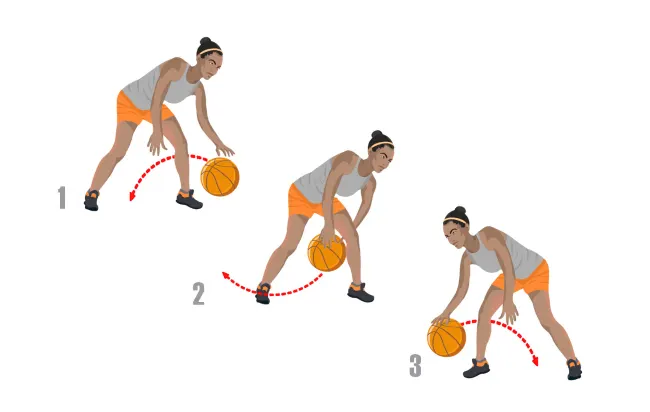
Source: Online Basketball Drills
Players set their legs shoulder-width apart and dribble the ball in a figure-eight pattern through and around their legs. They should focus on keeping their head up and maintaining a rhythm.
7. Cone dribbling
Cones are set up in a straight line or zig-zag pattern, and players must dribble the ball around each cone. The goal is to keep the ball close and use both hands to navigate the course. As skills develop, players can reduce the space between cones or incorporate more complex maneuvers around each cone.
8. Full court layups
Players start at one end of the court, dribble full court, and finish with a layup. After making (or missing) the layup, they immediately retrieve the ball and dribble back to the starting end.
This drill combines ball handling with speed and endurance, simulating a fast-break situation in a game. You can introduce challenges like adding defenders or setting a time limit for an added layer of difficulty.
Passing drills
9. 5 star passing drill

Source: Online Basketball Drills
The 5 star passing drill is a great way to work on passing teamwork, the hands of your players, their footwork, and communication skills. All you need for this drill is one basketball and 10 or more players.
You can start the drill by having at least two players on each point of the 5 stars. The points you want the players to be around are: under the basket, and then each corner of the half-court. The ball always starts under the basket and that player passes it to their right and then follows that pass until they're in the back of the line in their new point.
The player who caught the ball is then going to pass to the baseline corner on their right and the 3rd player should pass it to the opposite baseline corner. The 4th player is then going to pass to the last point player who's cutting for a layup. From there just repeat the drill.
10. Partner passing
Source: Online Basketball Drills
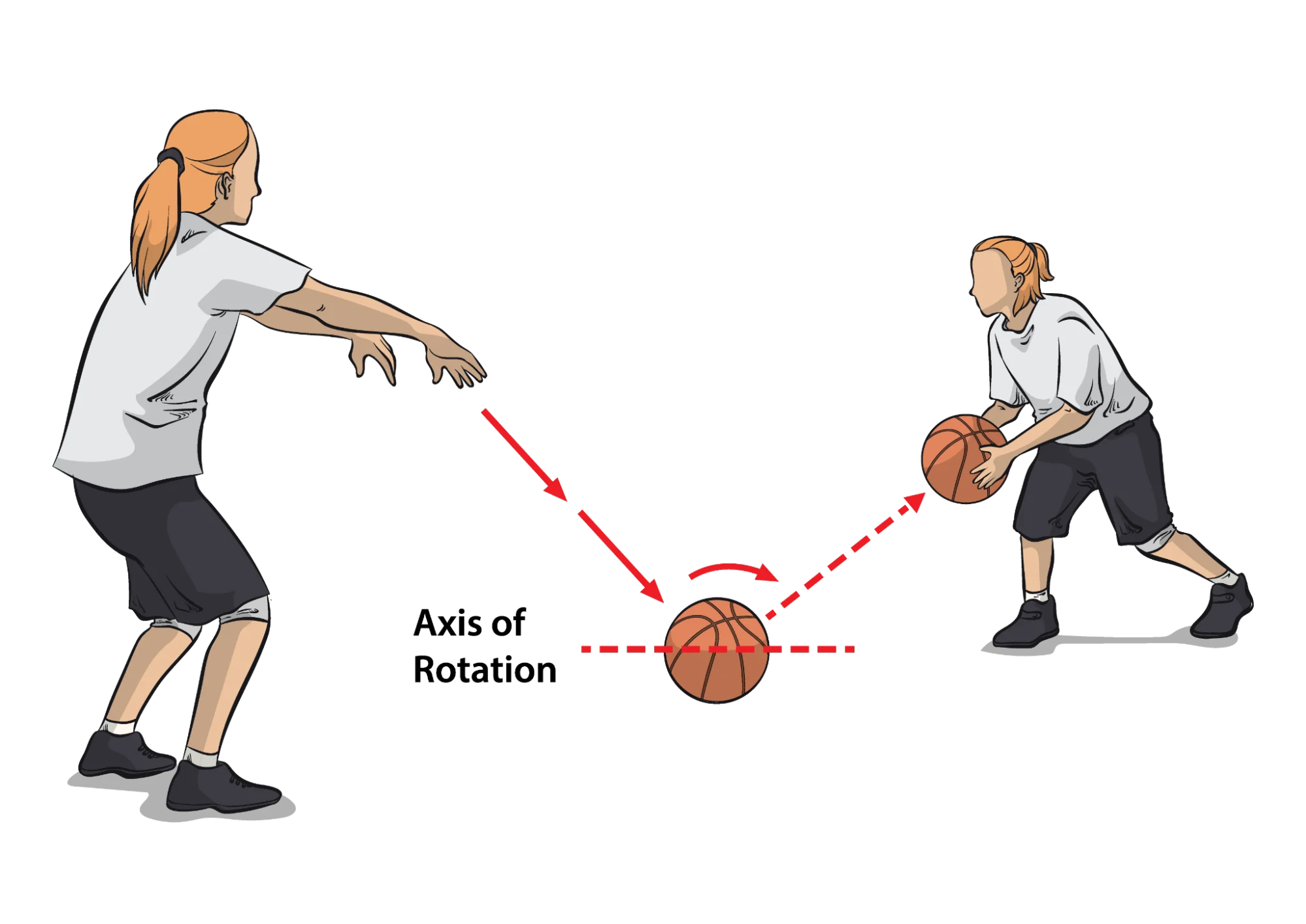
Players pair up, standing a few feet apart, and pass the ball back and forth using different types of passes. They can start with chest passes, then progress to bounce passes, overhead passes, and one-hand push passes.
As players become proficient, the distance between them can be increased, or they can be challenged to pass under defensive pressure.
11. Triangle passing
Three players form a triangle, each standing at a corner. One player starts with the ball and passes to a teammate, then follows their pass to take the position of the receiver.
This continuous movement and passing help players improve their ball movement, spatial awareness, and footwork, all while understanding the concept of playing without the ball.
12. Give and go passing
Source: Hoop Student
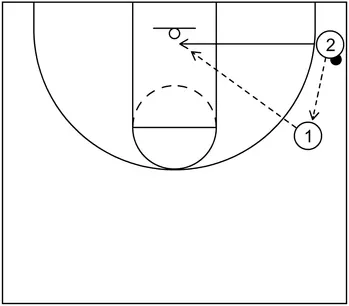
Two players work together; one with the ball, and the other without. The player with the ball passes to their partner and then makes a quick cut towards the basket or another open space on the floor.
The receiving player then immediately passes the ball back to the cutter, allowing them to either shoot or reset the offense. Practicing timely and accurate passes reinforces the foundational basketball principle of moving after passing.
Footwork drills
13. Ladder drills
An agility ladder is laid flat on the ground, and players perform various patterns stepping in, out, and across the ladder squares. Common patterns include the "Ickey Shuffle" or "In-In-Out-Out."
As players become more skilled, they can increase their speed or introduce ball handling into the drill to further challenge themselves.
14. Pivot practice
Source: Online Basketball Drills
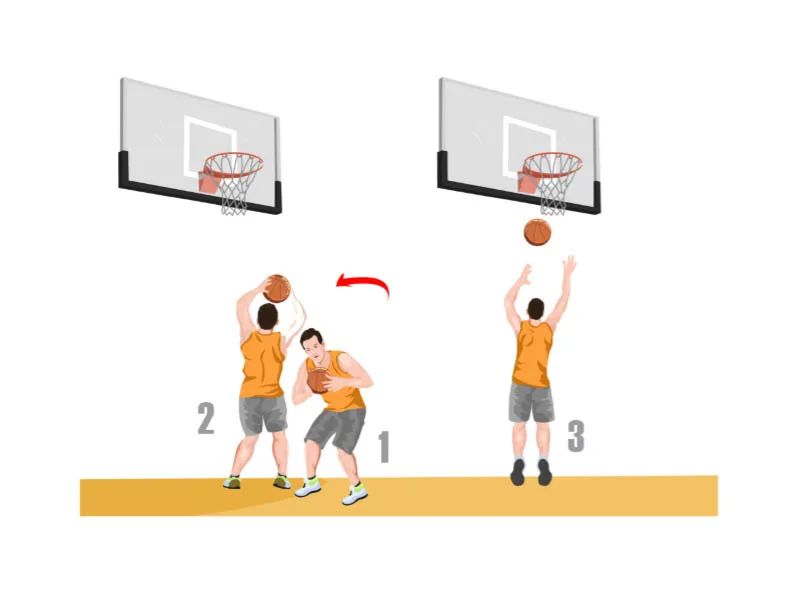
Players start by standing with a basketball in triple-threat position. They then practice pivoting on their front foot, turning both inwards and outwards, ensuring the pivot foot remains planted.
15. Jump stop
Players dribble towards a designated spot and then do a controlled jump stop, landing on both feet at the same time. They then establish a pivot foot which they can use to turn or fake before passing or shooting.
16. Box out footwork

Source: Online Basketball Drills
Players pair up, with one designated as the shooter and the other as the rebounder. The shooter tosses the ball towards the basket, and the rebounder uses footwork to "box out" or shield the shooter from getting to the ball.
The rebounder focuses on establishing a wide stance, maintaining contact with the shooter, and pursuing the ball once it bounces. It teaches players how to gain advantage over their opponent in rebounding situations.
Defense drills
17. Closeout
Source: Teach Hoops
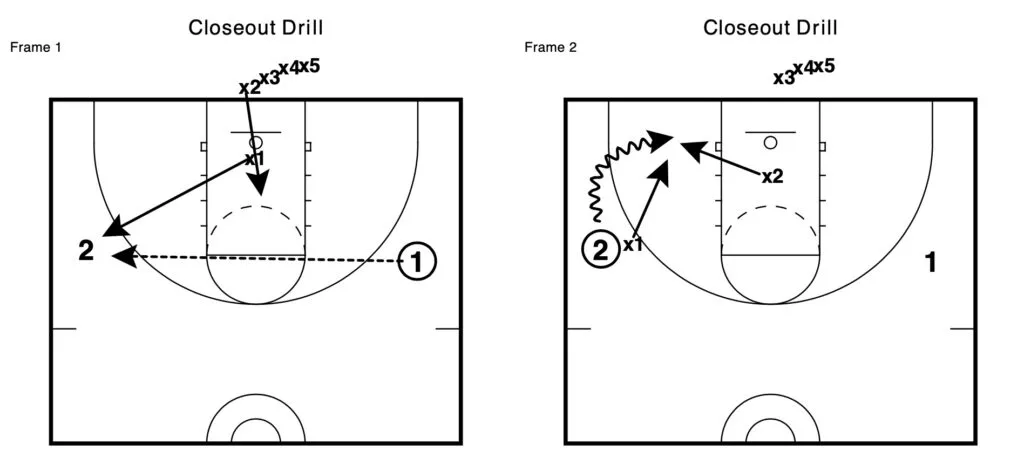
A player starts in the paint while another stands outside the three-point line with a ball. On the coach's cue, the outside player passes the ball to the coach, and the defender quickly "closes out" to them, ready to defend against a shot or drive.
18. Shell
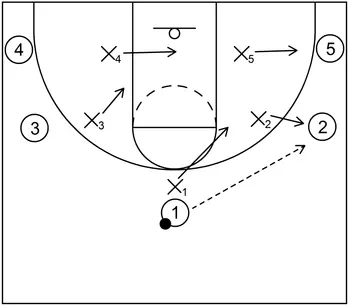
Source: Hoop Student
Four offensive players position themselves around the perimeter, with four defenders matched up. The offense passes the ball around, while the defense practices rotating and communicating to ensure every player is guarded.
Over time, coaches can introduce drives or screens to the offense, making the task more challenging for the defenders.
19. Zig-Zag defensive slide
The court is split into a series of diagonal segments using cones. A player starts at one baseline and slides diagonally from one cone to the next, mimicking the motion of guarding an offensive player.
20. One-on-One Stop
An offensive player starts at the top of the key with the ball, and a defender faces them in a defensive stance. On the coach's signal, the offensive player tries to dribble past the defender to score, while the defender's objective is to prevent the drive and force a tough shot or a turnover.
Offense drills
21. Fast break transition
Players start in a line at one baseline. On the coach's whistle, the first player sprints and dribbles to the opposite end to make a layup, followed by the next player receiving an outlet pass and doing the same. This drill mimics a fast-break scenario, emphasizing speed, ball control, and efficient scoring under transition.
22. Pick and roll
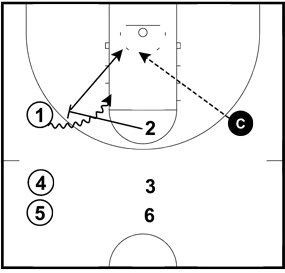
Source: Breakthrough Basketball
Two offensive players and a defender are set up. One player sets a screen (the "pick") for the ball handler, who then "rolls" around them. After setting the pick, the screener then moves ("rolls") towards the basket looking for a pass.
23. 3-on-2, 2-on-1 break
This starts with three offensive players against two defenders. The offense tries to score in the numerical advantage, and once a shot goes up, two of the three offensive players transition to defense, and two new offensive players join to form a 2-on-1 break going the other way.
The drill promotes decision-making, quick transitions between offense and defense, and capitalizing on numerical advantages. It's an excellent way for players to learn about spacing, passing lanes, and transition defense.
24. Post entry and move
An offensive player starts on the low block (post position) while another is on the perimeter with the ball. The perimeter player passes to the post, then makes a move (cut to the basket, fade to the corner, etc.). The post player then decides whether to shoot, pass back, or make a move.
Youth basketball endurance drills
25. Suicide sprints
Suicide sprints are a popular basketball conditioning drill that helps players build speed, stamina, and hustle. Players sprint to different lines on the court and back, mimicking the quick bursts of movement they use during games.
While they can be challenging, suicide sprints are a great way to improve fitness and encourage players to push themselves. Just be sure to keep the drill age-appropriate and mix it in with other fun practice activities.
Youth basketball individual drills
Teamwork is important in basketball, but players also need time to develop their individual skills. Working on fundamentals like dribbling, shooting, and footwork can help players build confidence and become more effective on the court. Here are a few individual drills players can practice on their own or during team workouts.
27. Full-Court ball handling drill
The purpose of this drill is to not only work on your players' ball handling, but also to work on their conditioning and speed.
The types of dribbles your players should be utilizing are:
- Speed Dribbles
- Crossovers
- Behind the Back
- Spin Dribbles
- Inside Out
To take this drill to the next level, you can instruct your player to do a set of moves together such as a crossover to between the legs. To amp the drill up even further, you can have your players really try to pick up their hand and movement speeds once they get the fundamentals down first.
28. Individual shooting drills
When it comes to shooting drills, it's all about establishing the right fundamentals and then building a rhythm. A good clean shot should feel fluid and require almost no thought, becoming purely muscle memory.
While individual shooting drills may seem tough for some of your players, the most determined ones will reap the benefits. Depending on how determined your players are to have a great shot, they can run these shooting drills for as little as 15 minutes to as much as a few hours per day. Just be sure to remind them that shooting is all about repetition!
A good starting point for shooting drills your players can do individually are baseline to baseline three pointers. This drill is great because you can shoot, get your rebound and run right to the next baseline all while keeping your rhythm. An added benefit of this drill is it indirectly works on your endurance.
Fun games and drills
29. Knockout
Players line up at the free-throw line, with the first two holding basketballs. The objective is to make a shot before the person in front of you, knocking them out if you do.
30. Dribble tag
All players dribble their basketballs within a defined area, trying to tag others without losing their own dribble. Once tagged or if they lose their dribble, players sit out or perform a task to get back in.
31. Sharks and minnows
One or two players (sharks) try to steal the ball away from the rest (minnows) as they dribble from one baseline to another. If a minnow loses their ball, they become a shark.
32. Hot shot competition
Using various spots on the court (e.g., free-throw line, elbows, corners), assign different point values and let players shoot from those spots within a time frame. The player with the highest score at the end wins.
33. Basketball bowling
Set up pins (or cones) at the end of the court. Players take turns rolling the basketball, trying to knock down as many pins as possible.
34. Monkey in the middle
Three players participate, with two passers and one defender (the monkey) in between. The objective for passers is to keep the ball away from the defender by passing over or around them.
35. Buzzer beater
Set up scenarios with limited time (e.g., 3 seconds) on the clock, and players must try to score before the "buzzer" (coach's whistle) sounds. It's great for practicing quick decision-making and last-second shots.
How to use these drills in practice
While this post may only highlight a few of the many great drills coaches can run for their players, they're a solid place to start when building out practice plans for your youth basketball program.
While running these drills, be sure to keep in mind the age and current skill level of your players. You can always start small and build from there! Becoming a master of these few drills can work wonders for your players' confidence by the end of the season.
If you're looking for a new sports management software, Jersey Watch can help you build youth basketball sign-up forms, communicate with coaches and parents, raise more money, and organize your team.
Build a stronger basketball program with Jersey Watch
These 35 drills give you a solid foundation to run balanced, effective practices all season long. Whether you're working on shooting fundamentals, building defensive habits, or just trying to keep things fun and competitive, the right drills make a real difference in how your team develops.
As your program grows, managing the off-court side of things shouldn't slow you down. Jersey Watch helps coaches handle registration, team communication, and fundraising all in one place.
FAQs
What are the best youth basketball drills for coaches to start with?
A simple place to start is with a mix of shooting, ball handling, passing, and one fun game. For example, coaches can pair Spot shooting or Layup lines with Stationary dribble, Partner passing, and Knockout. That gives players a balanced practice without making things too complicated at the start.
How many drills should coaches use in one practice?
It helps to keep practice manageable and choose a small mix of drills. How many you use will depend on your practice time and the current skill level of your players. Most teams will get more out of a few well-run drills than trying to rush through too many at once.
How do I choose the right drills for my team's age and skill level?
Start with simple drills that match what your players can handle right now. Younger or newer players may do better with basic shooting, dribbling, passing, and footwork before moving into more advanced team or conditioning drills. You can always start small and build from there as your players improve.

Sierra SwigertOperations Manager
Sierra Swigert is the Operations Manager at Jersey Watch. She works directly with youth sports organizations every day and writes educational resources based on her firsthand experience supporting league administrators and volunteers, as well as her background competing in cross country and track.


