6 Best Volleyball Club Management Software Options for 2026

Courtney Calvo Last updated: September 1, 2026
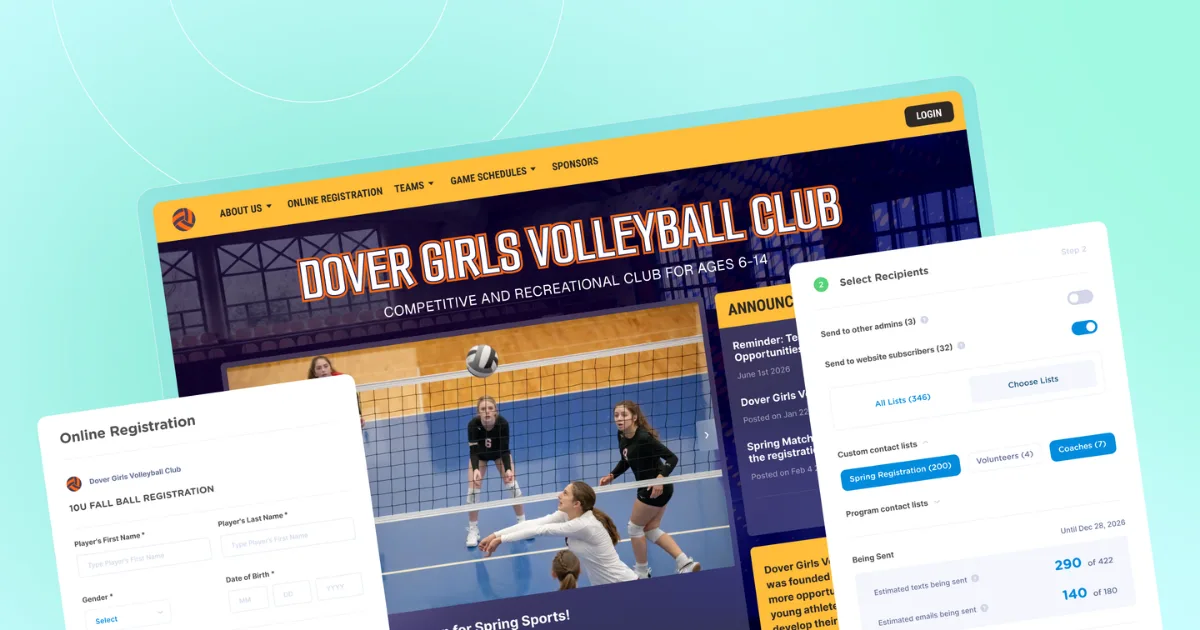
Table of Contents
Volleyball club management software centralizes your club’s website, registration, payments, schedules, communication, and records in one system. For volunteer-run clubs, the challenge is finding a platform that can handle those needs without adding more complexity.
You've already decided your volleyball club needs new software. Now you have a dozen browser tabs open, comparing features and prices, unsure which platform fits your small volunteer board. The best platform should match your size, shared-court needs, tournament format, and volunteer capacity rather than just offering the longest feature list.
This comparison lines up six platforms side by side, so you can pick the one that fits your divisions, gyms, and budget, then get back to running practice.

What is volleyball club management software?
Volleyball club management software gives directors one place to manage registration, payments, scheduling, communication, and other day-to-day club operations, so directors aren't managing five tools at once. Instead of juggling paper sign-up sheets, a spreadsheet of who's paid their club dues, and a group chat for practice changes, everything lives in one place that both the director and families can access.
For volleyball specifically, that can mean publishing shared gym and court schedules so three teams renting the same facility don't double-book, collecting travel team fees on a payment plan instead of multiple Venmo payments, and getting tryout information or pool-play tournament dates in front of parents. Anyone starting a volleyball club will encounter these tasks quickly.
The comparisons ahead weigh organizational fit and ease of use for volunteer boards over software functionality.
What should volleyball club directors look for in management software?
Volleyball club directors should evaluate any platform against a few core criteria, including:
- Website management
- Mobile-friendly registration
- Digital waivers
- Flexible payments
- Financial reporting
- Clear processing fees
- Scheduling
- Communication
- Tournament support
- Ease of setup
- Customer support
Start with the website. It's the hub that houses your registration forms, schedules and communication. Make sure the website can be created and edited without code, that a domain is included and that the platform takes care of hosting.
Next, look at registration and payment functionality. You may not be able to process payments without signing up so check online resources or reach out to support to verify what reporting and payment tracking look like.
Then, test scheduling against your real season. Create schedules and events for items that you’ve already scheduled out like games, fundraisers or tournaments. When generating new schedules, test creating blackout dates, managing team names and division-wide changes.
As a next step, send yourself an email and text message from the communication system. See if you can choose when a message is sent, look at how contact lists are created and check out each message’s status. Communication could look like a one to many email blast or have group chat functionality.
Finally, weigh the setup effort for volunteer boards, roster and coach management, background checks, support responsiveness, and total cost together. For a broader breakdown of what sets strong platforms apart, see this comparison of sports club management software.
Volleyball club management software at a glance
The six platforms compared here fit different volleyball club needs, ranging from volunteer-friendly administration to high-volume programs, tournament operations, communication, and player development.
The right fit depends on your organization’s daily operations, since no single platform works for every volleyball club. A volunteer-run rec club sharing rented gym courts needs something different from a high-volume travel program juggling camps and tournaments, or an academy focused on player development.
The rankings below match each platform to the volleyball organization it serves best. For a wider comparison across sports, see the sports league management software comparison. Before you commit anywhere, confirm current pricing directly with any provider that doesn't publish it.
Rank | Platform | Best for | Pricing | Top feature |
1 | Jersey Watch | Volunteer-run volleyball clubs with under 1,000 registrants | $19 for the first month, then $348 billed annually | Website, registration, and payments in one platform |
2 | Byga | Larger, performance-oriented organizations | Contact for pricing | Athlete and coach development tracking |
3 | LeagueApps | Established, high-volume programs | Percentage of transactions plus setup fee | Camp, tournament, and travel program tools |
4 | TeamSnap ONE | Team communication | Contact for pricing | Team chat and push notifications |
5 | SportsEngine | Larger multi-team organizations | Contact for pricing | Tournament registration and bracket management (AES) |
6 | 360Player | Player development and training | Contact for pricing | Player development tracking and video analysis |
1. Jersey Watch: Best for volunteer-run volleyball clubs
- Pricing: $19 for the first month, then $348 billed annually.
- Top feature: Website, registration, and payments in one platform.
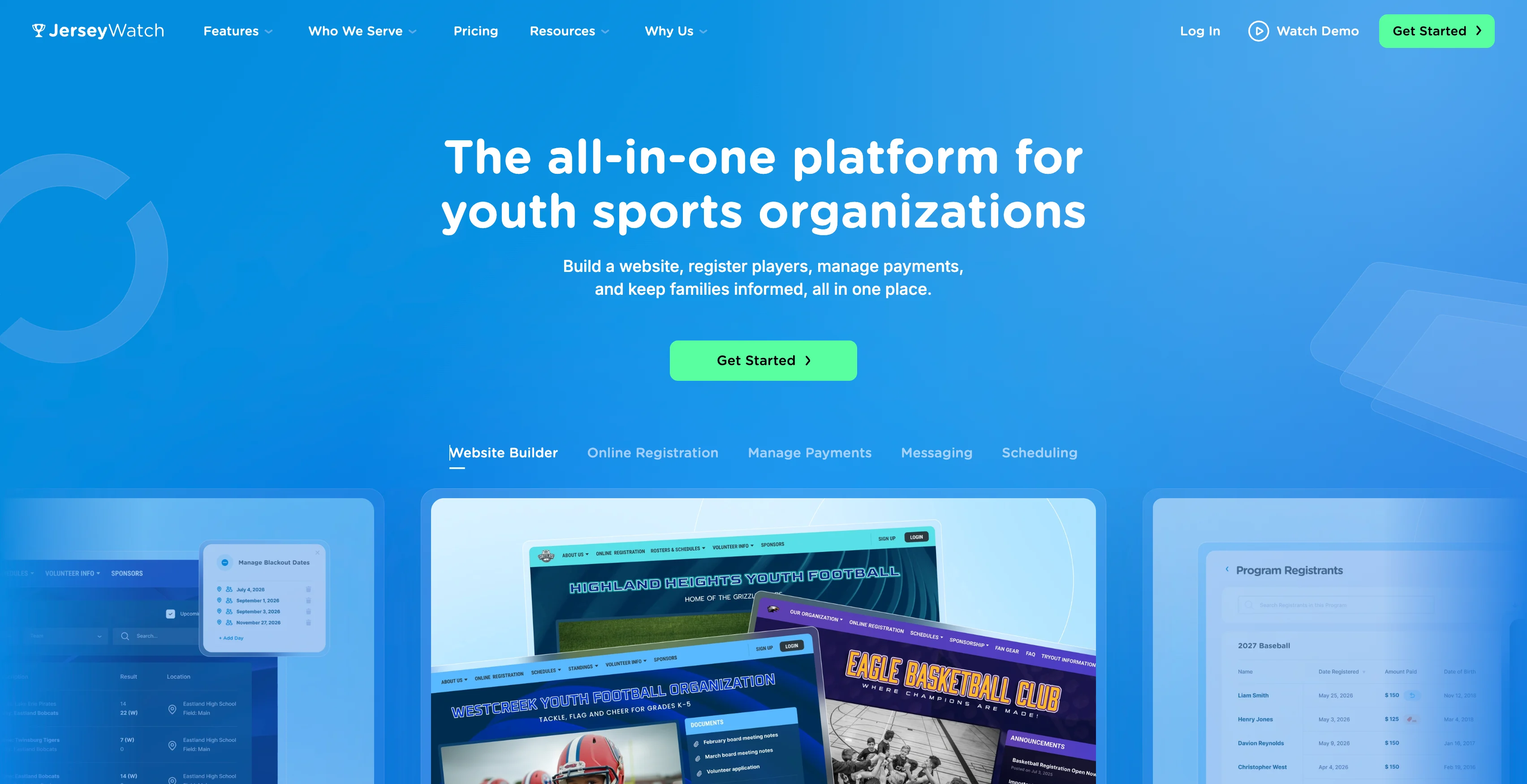
Jersey Watch works best for volunteer-run volleyball clubs that want a single, easy-to-manage platform rather than a stack of separate tools. Its website, registration, payments, scheduling, and communication tools are available within one platform designed for organizations without dedicated technical staff.
For clubs with 50 to 1,000 players, a key benefit is moving away from paper forms and cash payments. Families sign up and pay club dues, camp fees, or tryout costs through a volleyball-specific setup on the club’s website, with digital waivers, payment plans, and multi-registrant discounts available.
Scheduling, standings, and text and email alerts support gym-time changes and last-minute cancellations. Background checks are also available for clubs that need them for volunteer coaches.
Jersey Watch positions itself around ease of use and responsive support rather than enterprise-level complexity, and it's trusted by more than 2,800 organizations with a 4.7-star rating across over 235 G2 reviews. Its Customer Care team also helps with setup. Content transfers from an existing website are typically completed within one business day after signing up for a plan.
You can explore the platform for free. When you’re ready to launch, the first month costs $19 and includes setup help, followed by $348 billed annually.
2. Byga: Best for larger, performance-oriented organizations
- Pricing: Contact for pricing.
- Top feature: Athlete and coach development tracking.
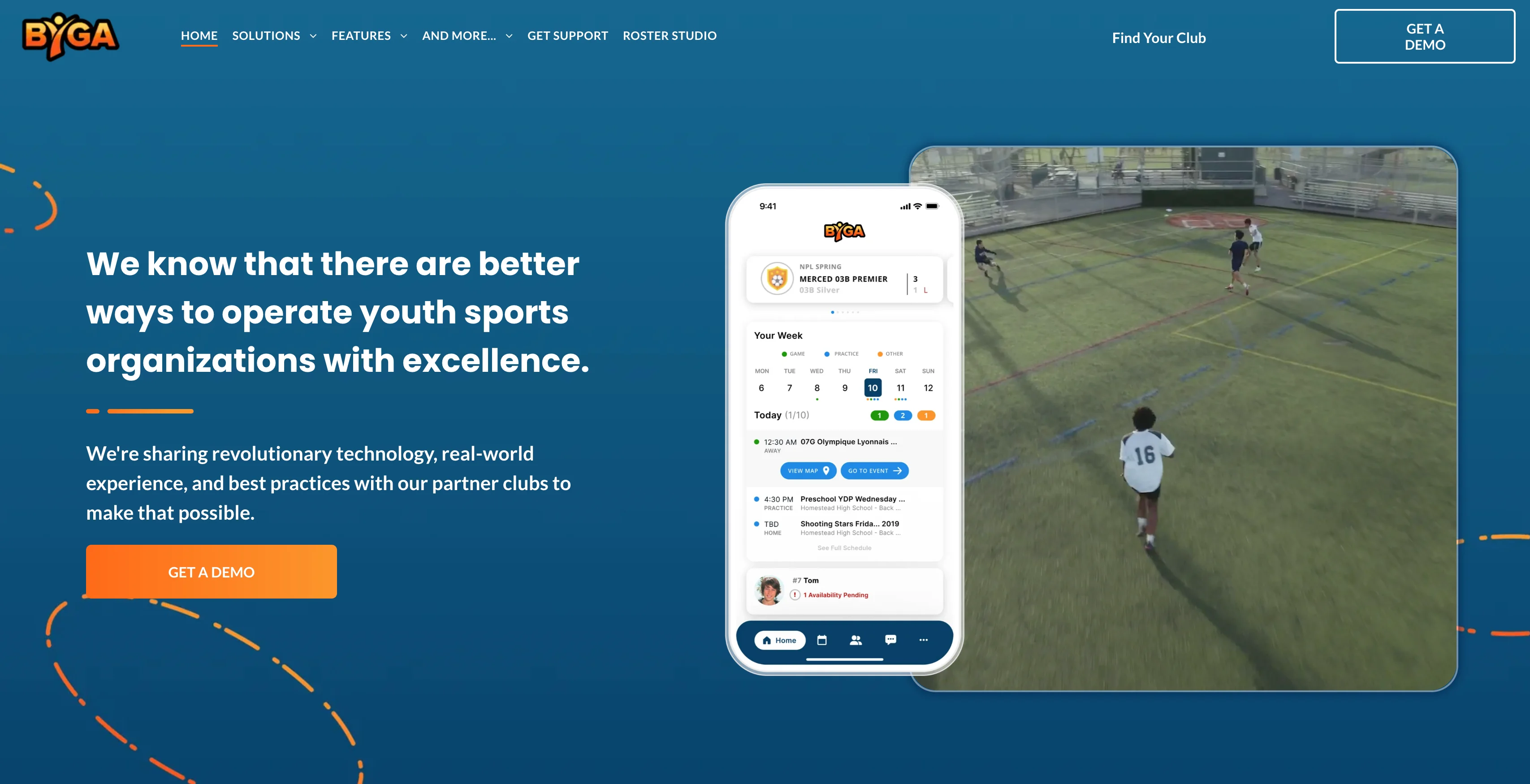
Byga is best for larger, performance-oriented volleyball organizations that need detailed administration, facility scheduling, reporting, and athlete development tools in a single environment. It suits competitive clubs juggling several teams, divisions, and programs at once, particularly those looking to move complex operations out of spreadsheets and paper-based systems.
Its dashboard pairs automated scheduling and facility management with financial reporting and roster tools, so directors overseeing multiple gyms and age groups can manage those workflows in one place instead of piecing them together team by team.
Byga also integrates athlete and coach development tracking into the same environment, giving performance-focused clubs a way to connect operations with player development.
Since pricing is not public, confirm current costs and implementation requirements directly with Byga's sales team through an online demo before committing.
3. LeagueApps: Best for established, high-volume volleyball programs

- Pricing: Percentage of transactions plus a one-time setup fee.
- Top feature: Camp, tournament, and travel program tools.
LeagueApps is best for established, high-volume volleyball organizations that manage camps, tournaments, travel teams, and recurring payments across several programs. It has a dedicated volleyball product page covering club, camp, tournament, and league program types.
That structure can be useful once a club is running multiple programs beyond a single rec season. LeagueApps pairs registration with waivers, auto-billing and payment plans, and tools for managing camps, club teams, and tournaments. Custom website services are also available for organizations that want a more developed online presence. Members receive access to the NextUp youth sports leadership community as well.
The platform may be especially well-suited to organizations with high registration and payment volume or several programs running at once. LeagueApps also holds a 4.8 out of 5 rating on G2 from 21 reviews.
LeagueApps doesn't publish flat pricing. Instead, it charges a percentage of online payment transactions plus a one-time setup fee, so your cost scales with registration revenue. Confirm current rates and tournament workflow fit directly before switching your club over.
4. TeamSnap (TeamSnap ONE): Best for team communication

- Pricing: Contact for pricing.
- Top feature: Team chat and push notifications.
TeamSnap ONE is a strong fit for volleyball clubs that prioritize coach-to-parent communication and want a mobile app families may already know. TeamSnap markets itself as the top app for youth sports team, club, and league management, and its coach-and-parent mobile experience remains a central part of the platform.
Inside the app, team chat and push notifications sit alongside RSVPs, shared schedules, and rosters, with registration and payments integrated into the same experience.
TeamSnap ONE also includes club administration, registration, payments, scheduling, and background checks in the same app families already use for team chat. It also includes features like live streaming and game highlights.
TeamSnap ONE pricing is based on several factors so before switching, confirm current pricing directly with their team.
5. SportsEngine: Best for larger multi-team organizations
- Pricing: Contact for pricing.
- Top feature: Tournament registration and bracket management (AES).
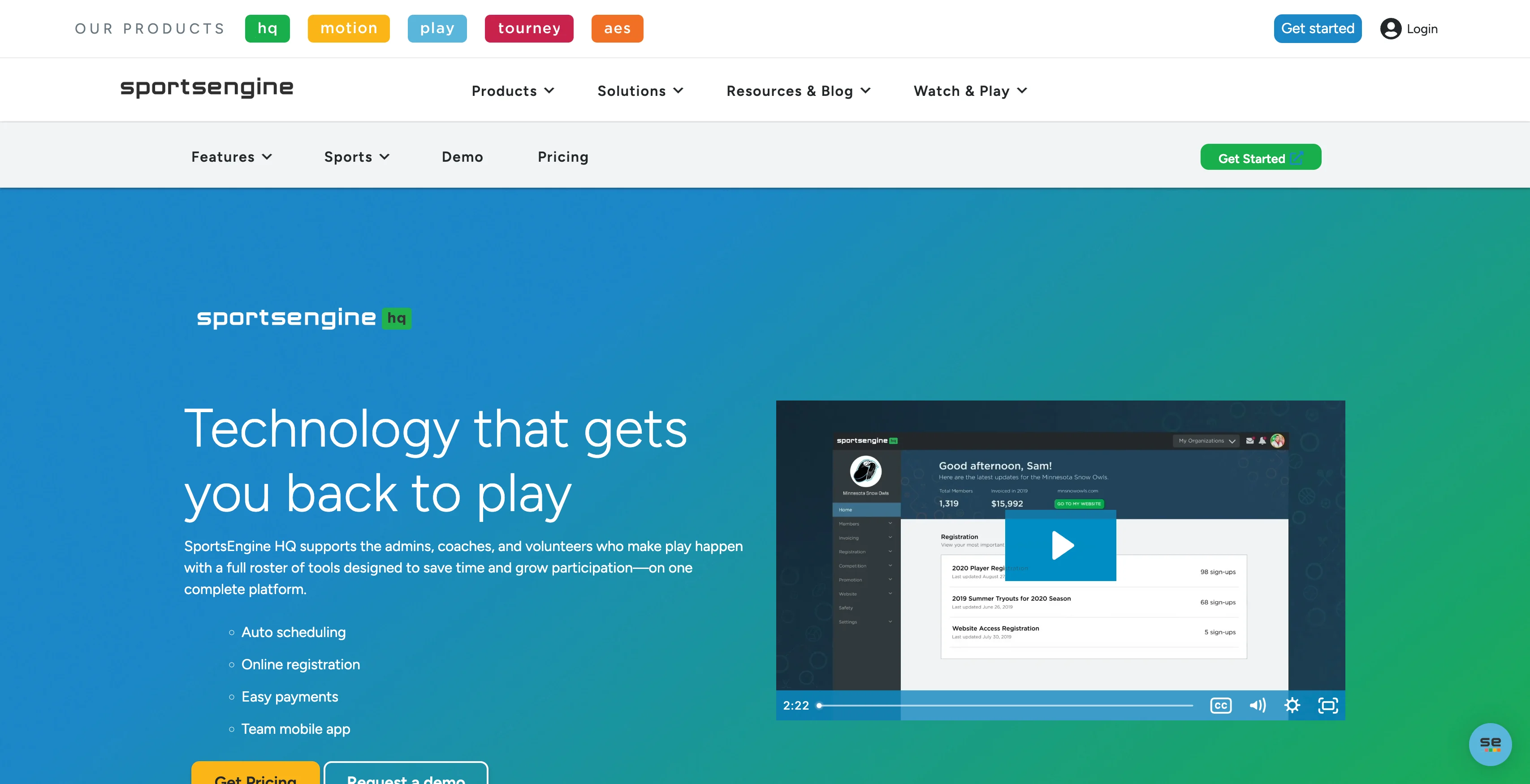
SportsEngine is best for larger volleyball organizations coordinating many teams, divisions, and competitive events at once. It's a name club directors may already recognize, powering 45,000-plus organizations, with USA Volleyball listed among its sport partnerships.
SportsEngine HQ handles day-to-day club administration, including registration, scheduling, and a team app for rosters and financials. SportsEngine AES is a separate product that SportsEngine describes as "the only platform purpose-built for volleyball competitions," built specifically for tournament registration and bracket management rather than season-long admin.
The platform also includes Motion, Tourney, and Play as distinct products, so covering both regular-season play and multi-day tournaments may mean using more than one product. For a volunteer board, that setup effort is one factor to weigh alongside the platform's broader capabilities.
SportsEngine was acquired by PlayMetrics in May 2026, so confirm current product, pricing, and support details directly with the vendor. Before committing, also check payment processing fees and determine which product(s) you’ll need.
6. 360Player: Best for player development and training

- Pricing: Contact for pricing.
- Top feature: Player development tracking and video analysis.
360Player is best for competitive volleyball clubs that want coaches actively tracking player development alongside registration and rosters. It bundles a player development app, a training and season-planning library, and video analysis and statistics tracking with standard scheduling and registration.
The platform's client references skew toward professional academies rather than volunteer-run volleyball clubs, including Scottish Volleyball, the national governing body of volleyball in Scotland. Outside of volleyball, most of their customers are elite soccer programs, and the client list reflects the platform’s emphasis on performance development.
Based in Sweden with a North American office, 360Player has an international footprint that differs from those of the other U.S.-based platforms on this list.
Full club onboarding typically takes one to four weeks depending on membership volume, so plan launch timelines accordingly. Confirm current pricing, implementation requirements, and support for shared facilities and tournament formats before switching platforms.
Choose the best volleyball club software for your volunteers
The best volleyball club software for your volunteers handles the real demands of your seasons: a website that parents can check for up-to-date schedules, registration that runs from a phone, and alerts that reach parents before they show up at the wrong door.
For volunteer-run clubs, Jersey Watch makes it easy to test website setup, registration, scheduling, and communication against your own workflows before committing. Larger or development-focused programs may need broader capabilities, but volunteer boards should prioritize ease of use, responsive support, and predictable costs.
If you're ready to see how your divisions, courts, and families fit into a system built for volunteer-run club management, get started for free.
FAQs
How much does volleyball club management software typically cost?
Most volleyball club management platforms use a flat monthly or annual subscription fee, a fee tied to registrations, online payments, or both. Total cost usually changes with participant volume, feature depth, and the number of programs being managed. Smaller volunteer-run clubs generally need a simpler, lower-cost setup than large organizations running travel teams, camps, and tournaments.
Do all volleyball registration platforms charge payment processing fees?
No single fee structure applies across every platform, but online credit and debit card payments generally involve processing fees because card processing carries an underlying cost. The rate should be clearly published and predictable rather than buried within a complicated pricing model. Ask each vendor for its exact transaction rate and any additional setup, subscription, or registration fees before comparing total cost.
Can volleyball club software handle scheduling across multiple gyms or shared courts?
Many volleyball club platforms can handle scheduling across multiple gyms and shared courts, though the depth of scheduling for courts and facilities varies by vendor. A club sharing gym space should confirm that the system can assign divisions, teams, courts, locations, and time slots without causing double bookings. Test the scheduling workflow with your real facility list and court availability before making a decision.
Does volleyball club software support pool play and bracket tournament formats?
Not every volleyball club platform supports pool play or elimination brackets because many general scheduling tools are designed for regular-season calendars. Clubs that host tournaments should verify pool assignment, bracket generation, score entry, advancement, and schedule publishing directly with each vendor. Some clubs may need a dedicated tournament tool alongside their main management platform.
How do I choose the right software based on my club's size?
Smaller, volunteer-run clubs usually benefit from straightforward systems that require little technical setup or ongoing administration. Larger clubs managing multiple teams, facilities, camps, or tournaments may need deeper reporting and multi-program tools. Match the platform to your volunteers' available time, technical comfort, and actual workflows, rather than choosing based on participant count or feature volume alone.

Courtney CalvoCustomer Care Team Lead
Courtney Calvo is the Customer Care Team Lead at Jersey Watch, where she helps youth sports organizations get started with registration, websites, and league management tools. She brings both professional expertise supporting leagues and firsthand experience as the parent of a youth soccer player.


